Laddar...

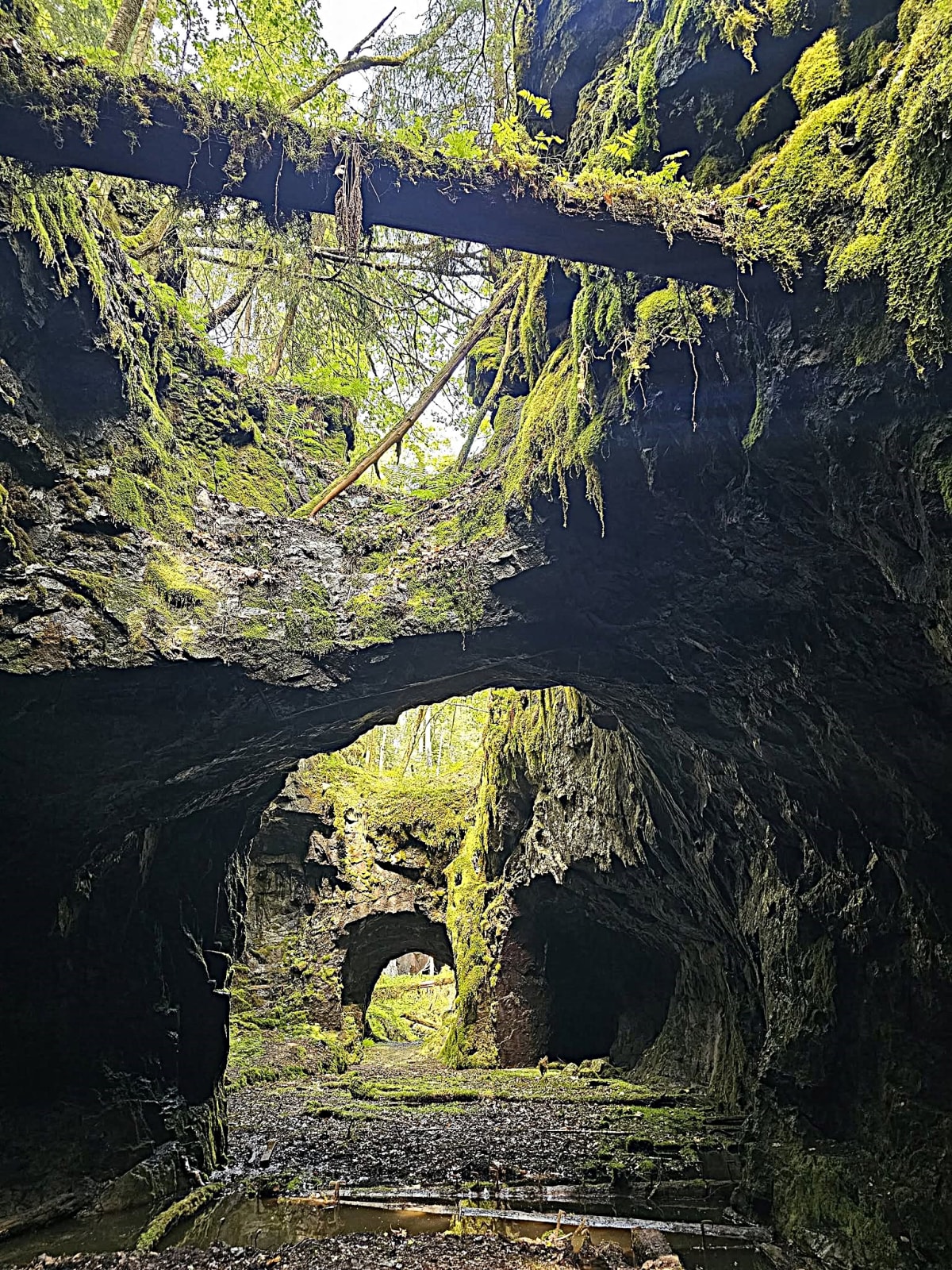
After walking through Tila’s adit, the visitor emerges at the Krakbo Mine.
The mine is probably very old. In the “Relations concerning the mines of the Filipstad mining district”, Nedre Högberg Mine is mentioned in 1686, described at that time as an abandoned mine.
In 1694, the mine is recorded as having a length of 16 fathoms, and in 1709 a length of 40 fathoms.
In 1754, the length is stated to be 47 fathoms, and the mine is then referred to as Krakbo Mine (see also the section Depth and division of the mine).
Mining was carried out intermittently until 1905, when it became the second-last operating mine in the Högberg mining field.
At the time of closure, the mine had a depth of approximately 103 metres.
Construction and Pump Rod System
The drawing in figure 1 shows an impressive timber construction above the mine.
This structure supports the pump rod system, where it changes direction before continuing down into the mine.
The change of direction occurs over an angle beam, locally called a “doppare.”
The section of the pump rod system that extends down to the bottom of the mine is called the main rod.
The pumping power was supplied from Braskefallet at Flintkärret, approximately 1,200 metres from the mine.
Definition (Jernkontoret Mining Lexicon)
The main rod (Schachtgestänge) in water-powered pumping systems is the rod suspended from the angle beam that extends down into the pump shaft, to which the smaller pump rods are connected.
Depth and Division of the Mine
In 1754, the depth of the mine was 13 fathoms (approximately 23 metres).
A contemporary description states:
“Krakbo Mine: At the surface the ore must have been quite substantial, since the lode to a depth of three fathoms and a width of four fathoms has been worked over a length of forty-seven fathoms.
From this depth the mine is divided into four sinkings with two to three fathoms of rock left between them.”
Source:
Transcription from “The Origin and Development of Swedish Mining” by J. O. Carlberg, Professor of Mining Science.
