Laddar...
Torskbäcksgruvan
 Mine
MineCoordinates: 59.74679, 14.28706 (WGS84)
First mentioned in the records in 1738.
Operations ceased in 1888.
Depth: 217 m.
Length: approx. 250 m.
Production: approx. 255,000 tonnes.
Total for the Högberg field: approx. 524,000 tonnes.
Operations ceased in 1888.
Depth: 217 m.
Length: approx. 250 m.
Production: approx. 255,000 tonnes.
Total for the Högberg field: approx. 524,000 tonnes.
First mentioned in the records in 1738.
Operations ceased in 1888.
Depth: 217 m.
Length: approx. 250 m.
Production: approx. 255,000 tonnes.
Total for the Högberg field: approx. 524,000 tonnes.
Operations ceased in 1888.
Depth: 217 m.
Length: approx. 250 m.
Production: approx. 255,000 tonnes.
Total for the Högberg field: approx. 524,000 tonnes.
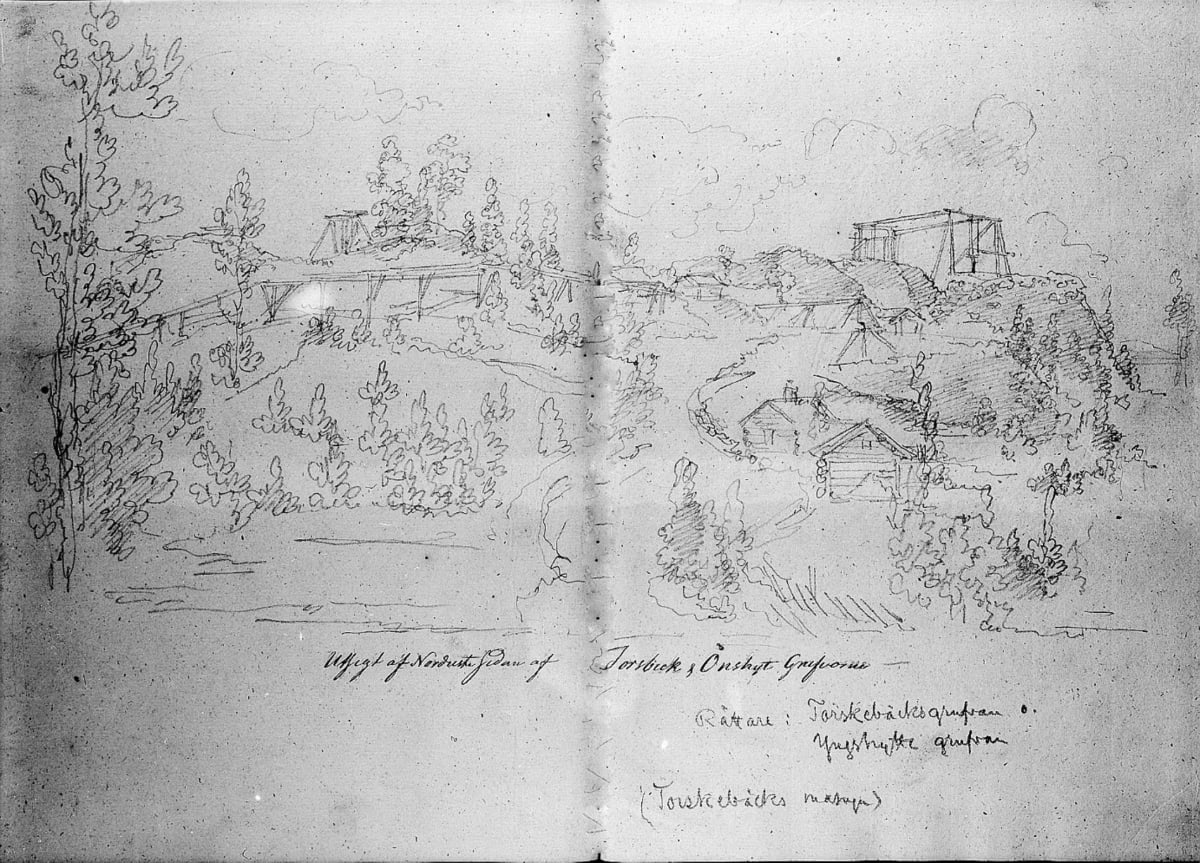
Archive: Jernkontoret. Drawing by Johan Hall.
Torskbäcksgruvan – The Largest Mine of the Högberg Field
Torskbäcksgruvan was the largest and most productive mine of the Högberg field, renowned for ore of very high quality. In 1813 the mechanical pump system was transferred here from the then-closed Yngshyttan mine. In 1851 the southern shaft was begun to facilitate the hoisting of ore from the mine. The mine was closed in 1888, at which point it had reached a depth of 217 metres.
History of Torskbäcksgruvan By P. Öberg
The mine is mentioned for the first time in the 1738 report. At that time it was 14 metres deep from its own headframe, with a width of 3.5 metres and a length of 9 metres.
The ore then increased in width until the mine had reached a depth of 60 metres, at which point the ore was almost displaced by a westerly compression. In 1755 work therefore began on removing the roof and the wall with the remaining ore. The southern field was opened up by means of a field level, and a more westerly parallel was sought, where the Kärr level and the Erik and Polheimer levels were established.
These works continued during the latter part of the 18th century and up to 1813, when the rock from the roof-work period was hoisted. After this time, work continued with the driving and sinking of the southern field level with bench-blasting.
During the 1830s the mine was worked intermittently, but between 1840 and 1858 operations lay dormant.
The Southern Hoisting Shaft (1851–1864)
The southern hoisting shaft was established in 1851 and broke through to the mine at its southern end.
- The southern field level was sunk annually until it reached the ore boundary at an elevation of 80 metres in 1864.
- At the same time the ore was benched down to the same southward-dipping skarn compression, where the floor had previously been set at an elevation of 70 metres.
- During 1860–1862 work progressed through the compression beneath the shaft and the ore was rediscovered, which was then followed by a field level towards the north beneath the previously established floor.
- In 1865 the level at an elevation of 85 metres broke through to the old (northern) mine from the 1830s.
Sinking and bench-blasting also continued in 1871–1874, when the mine’s barren footwall end was reached at an elevation of 115 metres.
In 1866 a new sinking was established between the two previous ones, with the aim of breaking through the barren skarn band. In 1868 the large ore body was encountered here, which was extracted during the 1870s and 1880s.
Ore Quality and Production of the Mine
In 1883 the ore began to mix with skarn, which increased with depth, so that the mine’s floor at this time was no longer worth working.
The ore in Torskbäcksgruvan and the other mines of Högberget was of a very high-quality black ore.
During the period 1860–1886, a total of 3,146,550 centner (≈ 133,752 metric tonnes) of ore were hoisted, which in general assay yielded:
- Prime ore: 54–60% pig iron
- Secondary ore: 45–50% pig iron
Persberg, February 1888. P. Öberg. Transcript: TN.

