Laddar...

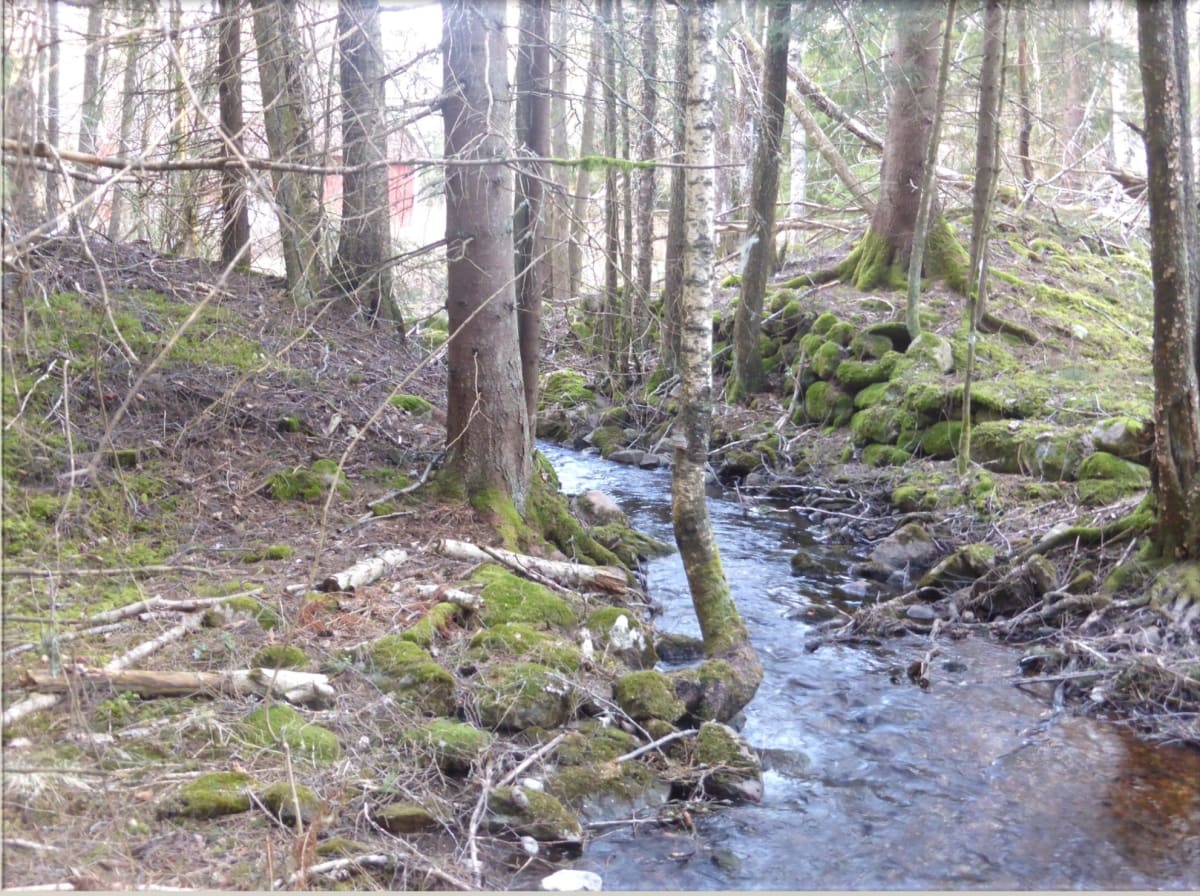
Household Mill at Yngshytteälv
General Description
The mill was originally a household mill, but after applying to the Royal Majesty (Kongl. Maj:t), permission was granted to grind grain for others for a fee. It was then converted into a Toll Mill.
The mill had two pairs of millstones, each driven by a separate water wheel:
-
One overshot wheel
-
One breastshot wheel
The mill building measured 10 x 8 meters, and both wheels were placed in the same wheelhouse.
Interestingly, two different types of wheels were chosen: the breastshot wheel did not require as much head as the overshot wheel and could be used even when the upstream water level was low.
Hammer slag
The riverbed at the site contains abundant hammer slag . Jan Vennerström confirmed these stones were slag from a hammer. Historically, there were two hammer forges in the river, built in 1621 and 1639. Records indicate that these were located between the blast furnaces near Yngshyttan, but it is possible that a hammer also existed at the mill’s location.
Legal Decisions and Permissions
The Royal Majesty’s Officer in Värmland County made decisions regarding the mill:
-
An application was submitted by co-owners in Yngshyttan, located in Fernebo District and Parish, to use the two pairs of millstones for grinding grain for others for a toll.
-
The District Judge and the council inspected the mill site and issued a statement on 19 August 1817.
-
The decision was formalized at the County Office in Karlstad on 27 April 1824.
Investigation by the District Court
The District Court confirmed:
-
No neighbor or nearby Odal mill owner had objections.
-
The mill is located on Yngshytteälv, which flows from Stora Sjön through forests and pastures, where damming would not cause damage.
-
Further downstream in the same river, the power wheels for Persberg mines are located.
-
The mill building measures 17 alnar (approx. 10 m) long and 14 alnar (approx. 8 m) wide and is equipped for the two pairs of millstones, each with its own wheel (overshot and breastshot) integrated into the wheelhouse.
-
During droughts, the water required for mine operations may be insufficient for the mill’s operation, but at least one pair of stones normally has enough water year-round.
-
Grinding for neighbors, especially mine claim owners and workers at Persberg Mines, was estimated at about 100 barrels of grain per year. The mill is closer than Saxå and Gammalkroppa (10 km) and Filipstad (approx. 7 km).
District Court Statement
-
As there was no toll mill within 7 km and many residents working at Persberg mines would benefit, it was deemed reasonable to allow the use of the mill for neighbors’ grain grinding against toll.
-
The mill owners would pay the royal toll to Kongl. Maj:t and the crown, as prescribed by law.
-
The decision was made on behalf of the County Governor by Kindberg and H.T. Oldvig.
-
The mill’s permission was confirmed during a land inspection at Bjurbäcken on 30 June 1824.
Reference
Copy of documents held at the Värmland Archive.
Torbjörn Nordwall

