Laddar...
The Krangruvan Hoisting House 1863
 Waterwheel
Coordinates: 59.74895, 14.26124 (WGS84)
Effekt: 16,43 hk
Fallhöjd: 10,41
Fallhöjd: 10,41
Effekt: 16,43 hk
Fallhöjd: 10,41
Fallhöjd: 10,41
The Krangruvan Hoisting House
The Krangruvan hoisting house was built in 1863. The hoisting engine received its water through a canal approximately 250 metres long, beginning downstream of the Krangruvan pumping wheel.
In 1881, the wooden building was completely destroyed by fire. To reduce the risk of future fires, a new hoisting house was constructed of slag stone, also known as cinder brick or Bergslagen stone.
Older photographs show that the original wheels were supplied with water via a wooden flume. In a photograph of the new hoisting house, however, it can be seen that the new wheels received their water through a pipe conduit.
Figures 2 and 3 show proposed designs for the hoisting wheels.
Figure 4 shows the control room, then referred to as the “hoisting chamber”.
The Väggruvorna Mines and Directional Changes of the Rope
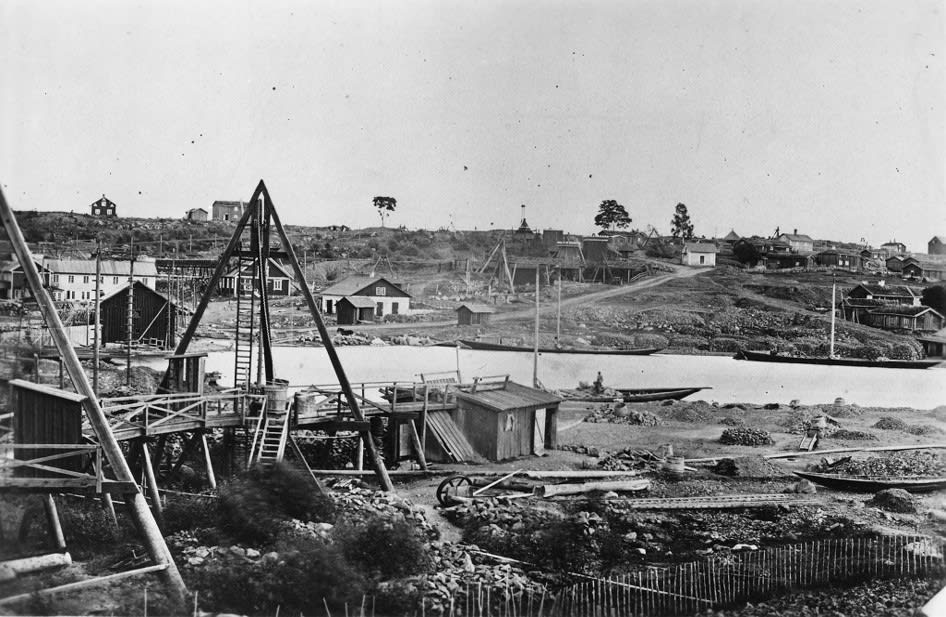
The simple three-legged headframe in the image belongs to the Väggruvorna mines, which received their hoisting power from the Krangruvan engine. The hoisting house is the building visible behind the headframe.
The rope runs toward the centre of the hoisting house, suggesting that a rotating roof-mounted pulley—such as the one shown in drawing 1—was likely used. This construction made it possible to serve mines located in different directions from the hoisting engine.
More commonly, a so-called rope deflection post was used, a construction in which a pulley wheel changed the direction of the hoisting rope.


