Laddar...
Kroppa Järnväg
 Land transport
Coordinates: 59.68401, 14.31087 (WGS84)
Järnvägens längd: 8,9 km
Byggdes år 1852-54
Byggdes år 1852-54
Järnvägens längd: 8,9 km
Byggdes år 1852-54
Byggdes år 1852-54
Kroppa Railway and Lake Transport Company
The company was founded in 1852 on the initiative of Patron C. G. Löwenhielm and Manager C. af Geijerstam.
Its purpose was to build and operate two railway lines:
-
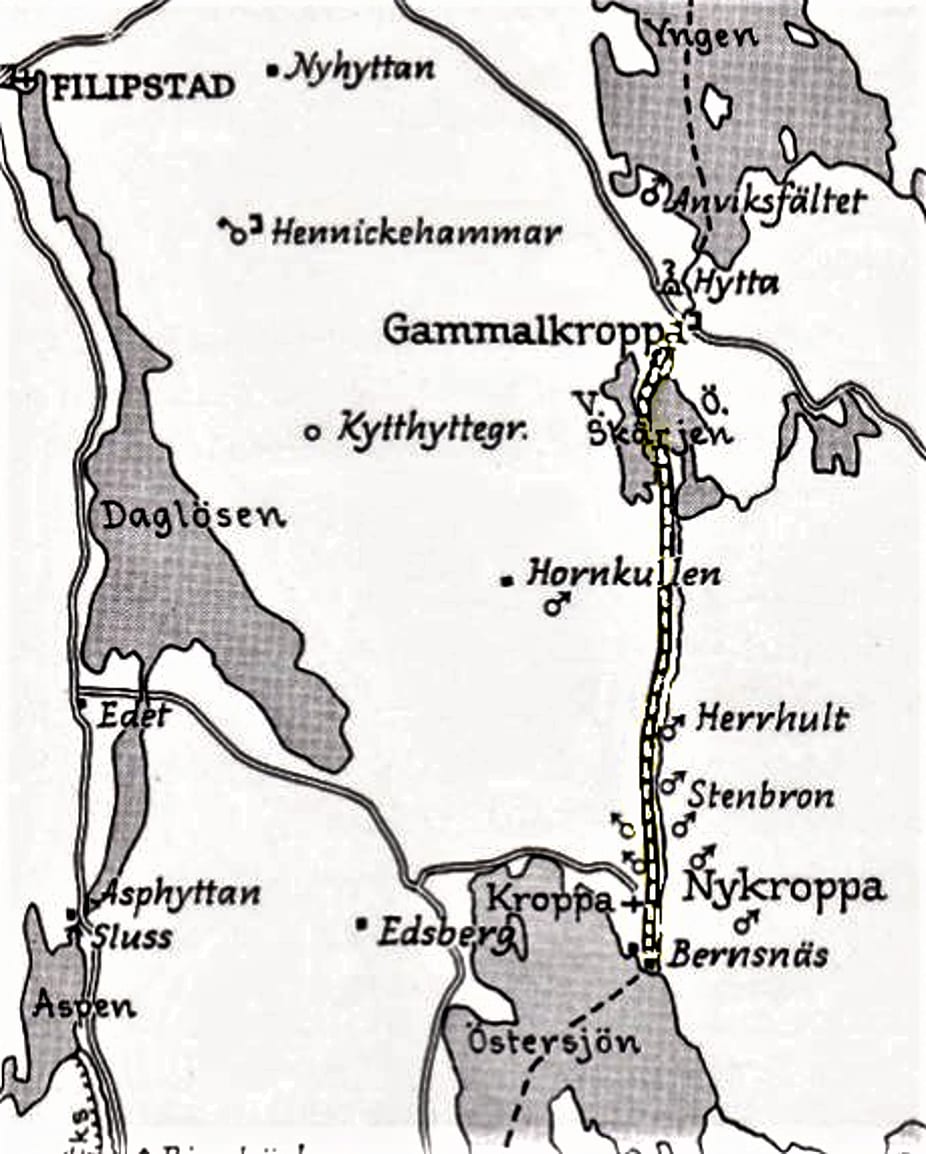
Gammalkroppa – Nykroppa, 8.9 km
-
Storfors – Lillfors, 1.9 km
The company would also operate transport on the lakes connected to the railways:
-
Lake Yngen, between Persberg and Gammalkroppa
-
Lake Östersjön, between Nykroppa and Storfors
-
Lake Öjevettern, between Lillfors and Sjöändan
The gauge of the railway was set at 32 Swedish verktum = 792 mm.
When horse traction was replaced by steam locomotives in 1869, the gauge was increased to 27 decimal inches = 802 mm.
Conversions:
-
1 verktum = 24.7 mm
-
1 decimal inch = 29.7 mm
Test of the pulling power of the locomotive Carl IX, 1870
At the request of interested parties, the undersigned has today tested the pulling power of the locomotive in use here and hereby submits the following certificate, together with some remarks on its performance during the traffic year 1870.
The locomotive in question was built at the Kristinehamn Mechanical Workshop and has been given the name Carl IX. It has a power of 25 horsepower.
The locomotive began operating on the Kroppa Railway in the spring of 1869 and has served during two summers, from the beginning of May until about the middle of November, to general satisfaction and to the great advantage of both the company and its customers.
The railway on which it operates has a length of 30,000 feet. The track gauge is 27 decimal inches, and the line contains steep gradients and sharp curves.
The steepest gradient is 1 foot in 35–40 feet, and the sharpest curve has a radius of 200 feet.
During the first months of the operating season – May, June, July and even August – the locomotive can haul 16 wagons and one passenger carriage, carrying 1,000–1,300 centners of goods, making eight round trips per day, corresponding to a traffic volume of 9,000–10,000 centners.
The number of journeys from Gammalkroppa to Bernsnäs during the operating year amounted to 832, with the same number in the opposite direction.
The transported weight amounted to:
-
Downward freight: 780,561 centners
-
Upward freight: 50,000 centners
Weight of the wagons:
-
Downward direction: 285,000 centners
-
Upward direction: 285,000 centners
Total transported weight:
1,400,561 centners
At the test carried out today, the season was not suitable, since traffic had ceased, the wagons had been unused for some time and the lubrication in the bearings had hardened. In addition, snow and rain had made the rails slippery, which required the use of sand.
The test was carried out on the so-called Kroppa Hill, which has a length of 2,300 feet and a gradient of 1 foot in 35–40 feet.
The train consisted of six wagons, built at the Kristinehamn workshop, each loaded with 100 centners of ore, making 600 centners, not including the weight of the wagons themselves, which amounted to 23 centners per wagon.
At 100 pounds of steam pressure, the locomotive climbed the gradient at a good speed.
Later tests were carried out with five wagons and 500 centners, with the same steam pressure, and the train then climbed the hill at a steady and good speed.
If such a test had been carried out during the summer, when everything was in full operation, I can assure that not only six wagons with 600 centners, but even seven wagons with 700 centners, could have been hauled up the Kroppa Hill by the locomotive Carl IX without difficulty.
Gammalkroppa, 24 November 1870
(Illegible signature)
Transcription: T. Nordwall
Archive: Värmlandsarkiv
Articles of Association
for the Kroppa Railway and Lake Transport Joint-Stock Company
§1
The company, named Kroppa Railway and Lake Transport Joint-Stock Company, has been formed with the purpose of maintaining regular transport on the railways owned by the company between the lakes Yngen and Östersjön, and between the lakes Mögsjön and Öjevettern, for the conveyance of goods and effects, against payment according to the tariff established by His Majesty the King.
Furthermore, the company manages the transport of goods on the boat routes connecting these two railways both with each other and with the railway between the Sjöändan loading place and the town of Kristinehamn.
§2
The company’s board has its seat at Storfors Works in Kroppa parish, Fernebo district, Värmland county.
Consequently, the Fernebo District Court constitutes the company’s legal forum in all cases where no other provision is established by law.
Transcription: T. Nordwall


