Laddar...

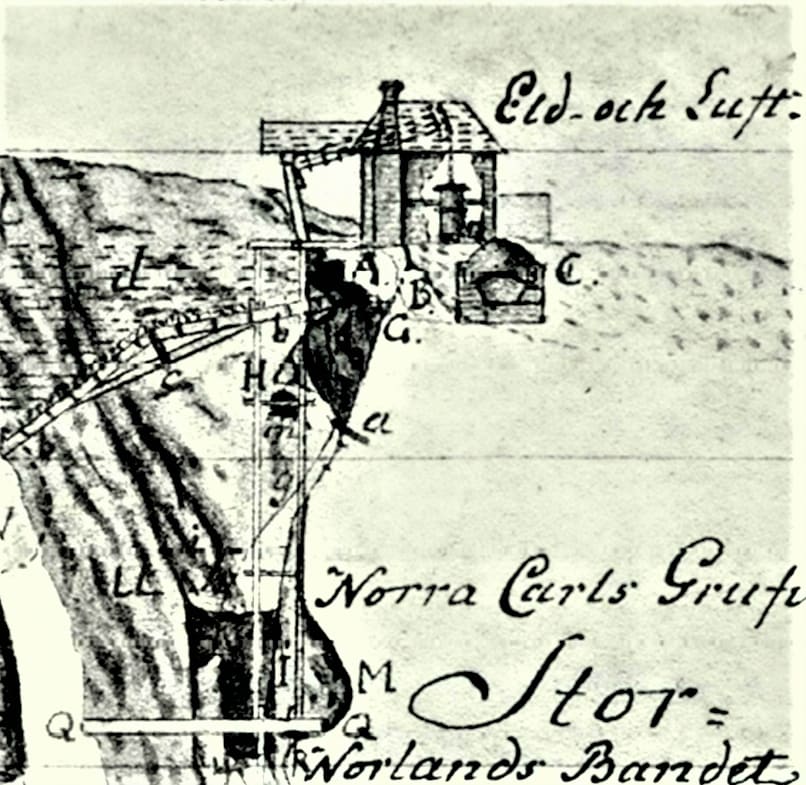
Map from 1731, revised by E. Geisler 1769. Commercial College mining maps, National Archives. Photo: Kurt Eriksson, RA
Fire and Air Engine at Persberg’s Main Mine
On May 3, 1768, the so-called fire and air engine was put into operation at the Main Mine in Persberg. The machine was an early atmospheric steam engine used to pump water out of the mine.
Already around 1770, problems began to arise. Several parts became worn, and the machine became difficult to keep operational. In 1772 it was taken out of service, and in the 1780s it was dismantled. After a period in storage, the machine was sold in 1800 by the Office of Mines to Höganäs Coal Company.
Contemporary description of the machine
In his diary from Crown Prince Gustav’s journey through Bergslagen in 1768, D. Tilas described the machine’s function:
-
The operation comes from a boiling water boiler. Steam rises through a pipe into a vertical cylinder and drives a piston upward. When cold water is introduced, the steam condenses, and the piston falls down again.
-
A control system is connected to the piston, which through its up-and-down movement drives the water works and pumps.
-
The upward movement of the piston is produced by steam pressure, while the downward movement is caused by atmospheric pressure as the steam condenses.
Problems with the rock beneath the machine
After some operation, cracks appeared in the rock under the machine. It was placed near the mine edge on the eastern side of the Main Mine.
To prevent the machine from falling into the mine, a structure of large timber logs – an “arch or parabola” – was built, spanning over 20 meters between the western mine wall and a large rock block, called a “skut,” which threatened to loosen.
Both the arch and the rock block are marked on the mine map. You can see a notch in the rock that likely prevented the block from sliding down, while the arch prevented it from tipping out.
It is hard not to marvel at how such constructions could be executed over the open mine with the technical means of that time.
Background of the machine
-
The steam engine was financed by ironworks owners in Värmland with funds advanced by the Office of Mines.
-
The Mining Board showed great interest in the project and ordered the machine’s main parts from Carron Company in Scotland via the trading house Jennings & Finlay.
-
A Scottish master builder was hired to assemble the machine in Persberg.
-
The operation worked well during the first years, but in 1771 and 1772 several stoppages occurred when parts of the control mechanism wore out.
-
The machine also consumed a large amount of fuel, which proved critics right:
“The steam engine needs an iron mine for its construction and a coal mine for its operation.”
Technical data (Johan Holmstedt)
Boiler
-
Diameter: approx. 4.45 m
-
Height: approx. 1.86 m
-
Made of forged iron plates.
Cylinder
-
Cast iron from Carron, Scotland
-
Length: approx. 3.3 m
-
Diameter: approx. 1.1 m
Mine depth
-
Main Mine: approx. 140 m
Pump capacity
-
Iron pumps: approx. 790 m³ of water per day
-
Wooden pumps: approx. 580 m³ of water per day
-
Total water pumped: approx. 1370 m³ per day.
Fuel consumption
-
The machine consumed about 4½ cubic meters of wood per day, equivalent to approximately 20 m³.
The machine was operated by four workers who took turns monitoring its operation.
Sources
-
Persbergs Malmtrakt – Harald Carlborg
-
Diary from Crown Prince Gustav’s Bergslagen journey 1768 – D. Tilas
-
Description of the Fire and Air Machine at Persberg Main Mine – Johan Holmstedt


