Laddar...

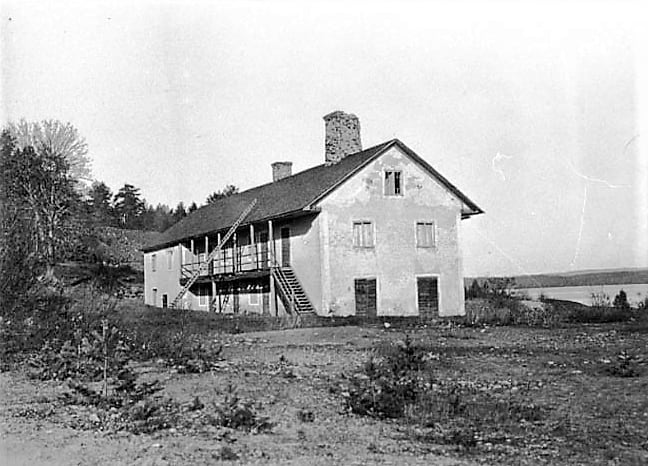
The Engine House at Högberget
The engine house contained not only the steam engine but also accommodation for 16 workers.
From the engine house, both the pump line and the winding line ran up to the plateau north of the building, where the power was distributed further across the mine field.
The Steam Engine from Hellefors
The background to the purchase of the steam engine was that the power that could be extracted from the waterfalls in the Persberg canal was insufficient for the needs of the mine field.
In the mid-1850s it was therefore decided to purchase a steam engine from Hellefors Mechanical Workshop.
The engine was installed during April–June 1858 under the direction of C. Setterqvist, apprentice at the Jernkontoret mechanical establishment in Falun.
Too Fuel-Hungry
Already after a few years of operation, the steam engine proved to be far too fuel-consuming and uneconomical as a primary power source. It was therefore subsequently used as a reserve power source.
After the regulation of the falls in the Persberg canal in 1860, the water power increased from 59 hp to approximately 99 hp.
The power distribution thereafter looked as follows:
- Pump power: from the pump wheel at Braskefallet
- Winding power: from the Hage winding gear, Braskefallet and the Storgruvan winding wheel
New Power Crisis in the 1870s
In the early 1870s, problems with the power supply at the Persberg mine field arose once again. An investigation was appointed and in 1874 it was proposed:
- That steam engines should provide the power at the Högberg field mines
- That water power should only be used at the centrally located mines on the Odal field
By switching entirely to steam power at Högberget, approximately 16 hp would be freed up, which was calculated to cover the Odal field’s needs for a further 8 years.
For Högberget it was proposed:
- A 30 hp steam engine for the pump
- A 10 hp steam engine for the winding gear
- A steam generator with three boilers (two in operation, one in reserve)
It was calculated that this would secure the power requirement for 15 years.
The Grand Adit Plan
An important reason for wanting to secure the power for precisely 15 years was the ambitious plan proposed by Anton Sjögren – an adit tunnel from Filipstad to Persberg.
It was estimated to take 10–12 years to build and, when completed, would provide access to as much as 200 hp – a quantity of power considered sufficient for ”100 years”.
The project was, however, a high-risk undertaking with an estimated cost of 1,500,000 kronor and was never carried out. The plan is known as Anton Sjögren’s or Karl XV’s adit.
Setterqvist’s ”Angle Rocker”
In 1858, Setterqvist also designed an improved type of rocker arm, which he called a ”vinkelbrott” (angle rocker). It is highly likely that this design was used at the Högberg field.
In the Jernkontoret Annals of 1858 one can read that Setterqvist led works at Högberget at Persberg, also concerning ”various other buildings there”.
(See drawings and descriptions in images 4–6.)
The Jernkontoret Mechanical Establishment
The Jernkontoret mechanical establishment was an organisation of technical representatives employed by Jernkontoret for technical supervision and support at the iron works.
It developed out of the earlier position of mine mechanic and had stations in, among other places, Avesta, Eskilstuna, Falun and Karlstad. The organisation existed until 1865.
Related p


