Laddar...

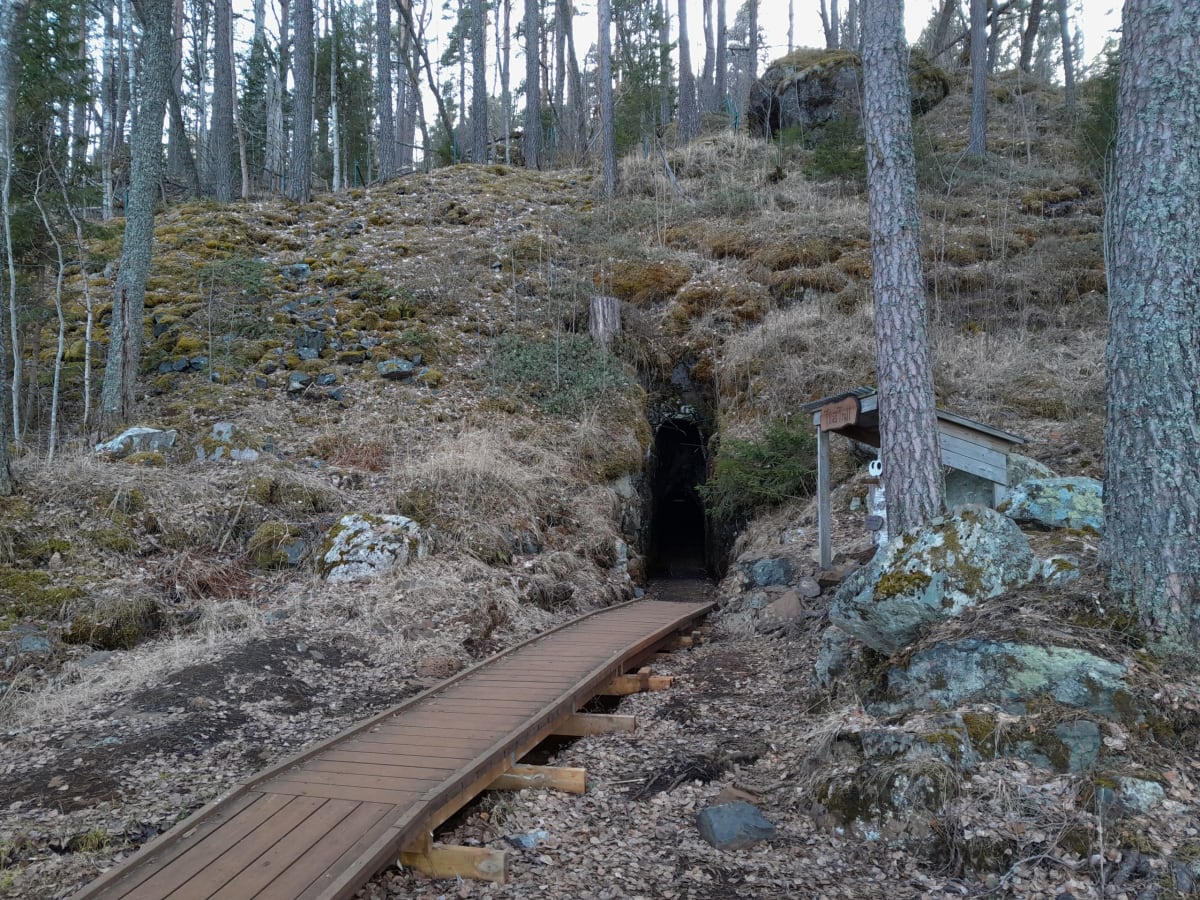
Safety in the Tilas Adit and Krakbogruvan
Be careful when entering the mine and do not leave the walkway bridge. There is no solid ground beside the bridge – only a plank covering.
As shown in the profile map (image 11), it is approximately 50 metres down to the bottom of the mine from the bridge.
The Tilas Adit
The adit takes its name from the mining councillor Daniel Tilas (b. 1712, d. 1772).
Tilas was a distinguished man who was honoured with many titles: Mining Councillor, Royal Herald, Baron, Genealogist, Titular County Governor, and Knight of the Royal Order of the North Star.
Some Assignments in His Life
- 1737 – participated in the planning of a canal construction in Finland.
- 1738 – travelled on behalf of the Board of Mines to Russia to study the mines around Lake Onega.
- 1741–1745 – participated in the work of the Boundary Commission to establish the border with Norway.
- 1761 – proposed to the Royal College that it approve the construction of a sawmill for the Persberg mines on the Yngshyttan river.
- 1768 – served as guide to Crown Prince Gustaf during his journey to the mines of Bergslagen. On 25 September the party arrived at the Persberg mine field, where the Crown Prince witnessed, among other things, a demonstration of the then unique ”Fire and Air Machine”.
The Great Ceiling Height at the Start of the Adit
The great ceiling height at the beginning of the adit has raised questions. The explanation is that after a few years of work – in 1769 – the advantage of lowering the floor of the adit to the highest water level of Lake Yngen was recognised.
Since hoisting was carried out with hand and horse whims, before water power was available, every metre of reduced hoisting height was of great importance.
On older maps one can see that the adit was used for hauling out ore. It naturally also served to channel the pumped mine water out into the lake.
Financing of the Work
In Persbergs Malmtrakt, Harald Carlborg writes:
”The Tilas adit at Högberget was probably the first joint undertaking to be carried out with the funds of the mine treasury, for as early as 1760 it was decided to advance it in this way by one fathom per year, after the funds obtained through the joint-account sale of a newly discovered deposit, Rudbeck’s vein, had been used up. In fact it was hoped that ’in time the mine fund will grow to such an extent that it can maintain the adit itself and sell the ore veins revealed therein at a clear profit as adit owner’. Unfortunately, however, the Tilas adit proved to be an entirely unsuccessful commercial venture.”
(1 fathom = 1.78 metres)
Details from ”Extracts from the Records of the Mines of Filipstad’s Bergslag…”
1760 The commission proposed opening an adit – the so-called Tilas adit – for the investigation of the Högberg ore field.
1762 Ground preparation did not require experienced mine workers, but ordinary labourers were expensive to hire as Filipstad was being rebuilt after the fire. ”Therefore postponed.”
1767 A rock ledge was blasted away in front of the adit entrance. Work then continued with mine labourers from Sala.
1768 Red flint rock made the work difficult. The floor had by then been driven 4 fathoms (approx. 7.1 m).
1769 The floor was lowered to the highest water level of Lake Yngen, a total of 2 ells (approx. 1.18 m).
1772 A note exists concerning the theft of firewood for blasting at the Tilas adit.

