Laddar...

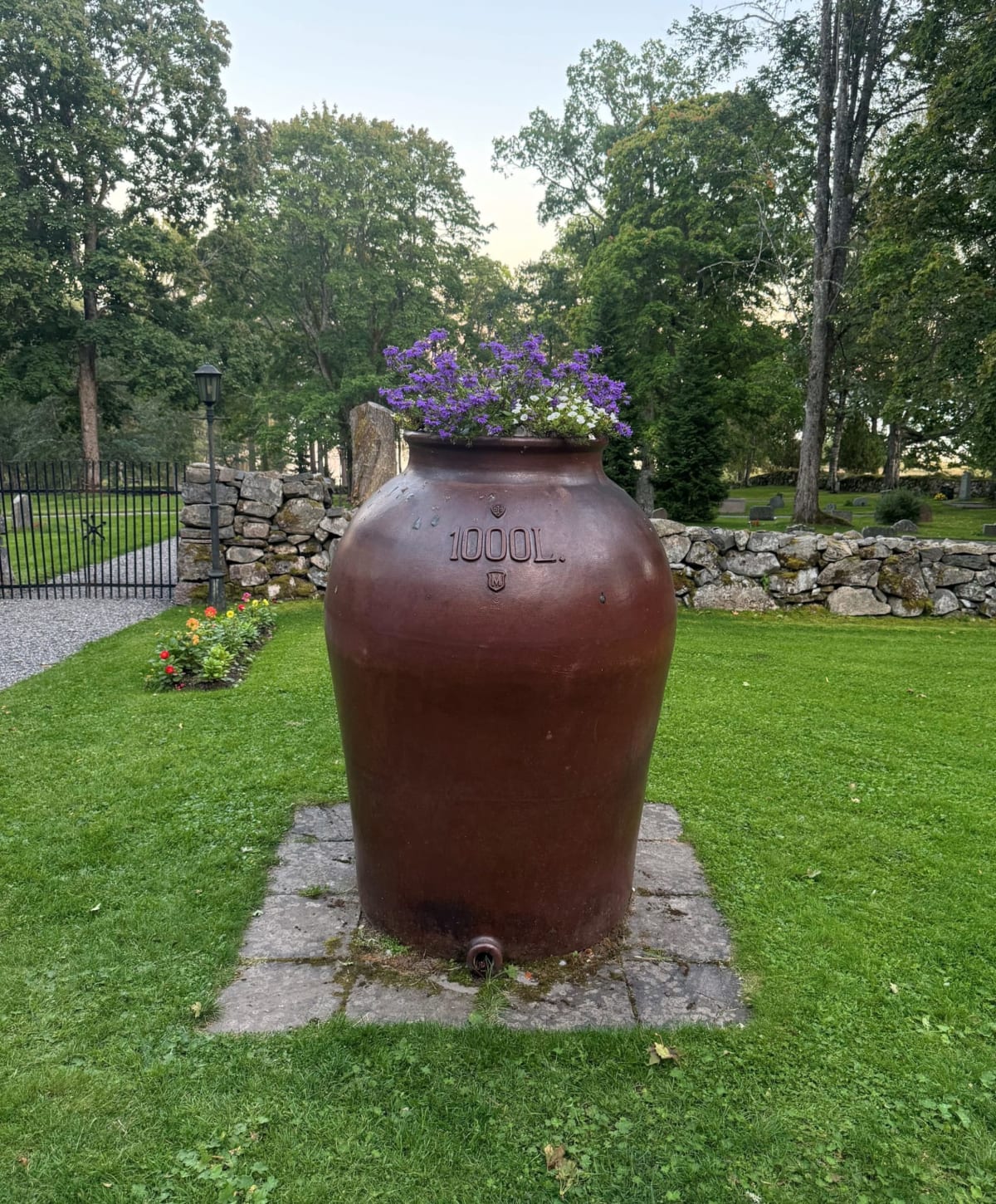
Industrial heritage at Skavnäset Chapel
The jar displayed at Skavnäset Chapel is an industrial heritage object with a fascinating history. Today serving as a decorative flower urn, it is in fact a 1,000-liter acid-resistant stoneware vessel from AB Persberg Explosives Factory (established as a nitroglycerin plant in 1874–1875).
Background of the factory
The factory, known for producing “Persberg dynamite,” was located in the historic industrial area of Yngshyttan, stretching along the Yngshytte River between the northern part of Gubbdammen and Lake Yngen.
According to local accounts, there were originally three identical vessels. One has unfortunately been destroyed, but two have survived. In addition to the urn at the chapel, another example is preserved at the SMA Mineral headquarters in Persberg.
World-leading German engineering
Producing such a large ceramic vessel in a single piece was a technological achievement in the 1870s. The thick walls allow it to withstand great weight, meaning it weighs several hundred kilograms even when empty.
The narrow neck was designed to minimize evaporation of hazardous chemicals, and at the lower front the round outlet opening remains visible, where an acid-resistant stoneware tap was once installed.
Manufacturer’s marks and origin
The markings on the vessel reveal its origin in detail:
- Upper shield (TDS): Refers to Thonwaarenindustrie Ludwigshafen am Rhein AG, one of Europe’s leading manufacturers of chemical-technical ceramics in the late 19th century.
- Lower shield (M): The letter “M” stands for the factory in Mannheim-Friedrichsfeld (Deutsche Steinzeugwarenfabrik). The two factories stood opposite each other across the Rhine, collaborated closely, and were later merged.
- Model and serial numbers: The number 12 in a circle indicates the model type, and the engraved number 3507 is a unique serial number used for quality control.
Containers for hazardous acids
These vessels were used to store and handle highly corrosive acids in nitroglycerin production, mainly concentrated nitric and sulfuric acids.
When mixed into nitrating acid, a strongly heat-generating reaction occurred, placing extreme demands on the material. Metal containers would have corroded quickly, but the hard-fired German stoneware proved highly resistant.
A pioneering era
In the early 1870s, Swedish stoneware production (such as Höganäs) was still developing such advanced chemical equipment. Persberg therefore imported the best available technology from Germany.
Today, these preserved vessels provide a direct link to a time when Yngshyttan and Persberg were at the forefront of technological development in Swedish mining.
