Laddar...
 Land transport
Inclined plane railway, Östra Hage Mine
- Coordinates:
- 59.74255, 14.27913 (WGS84) (opens in new tab)
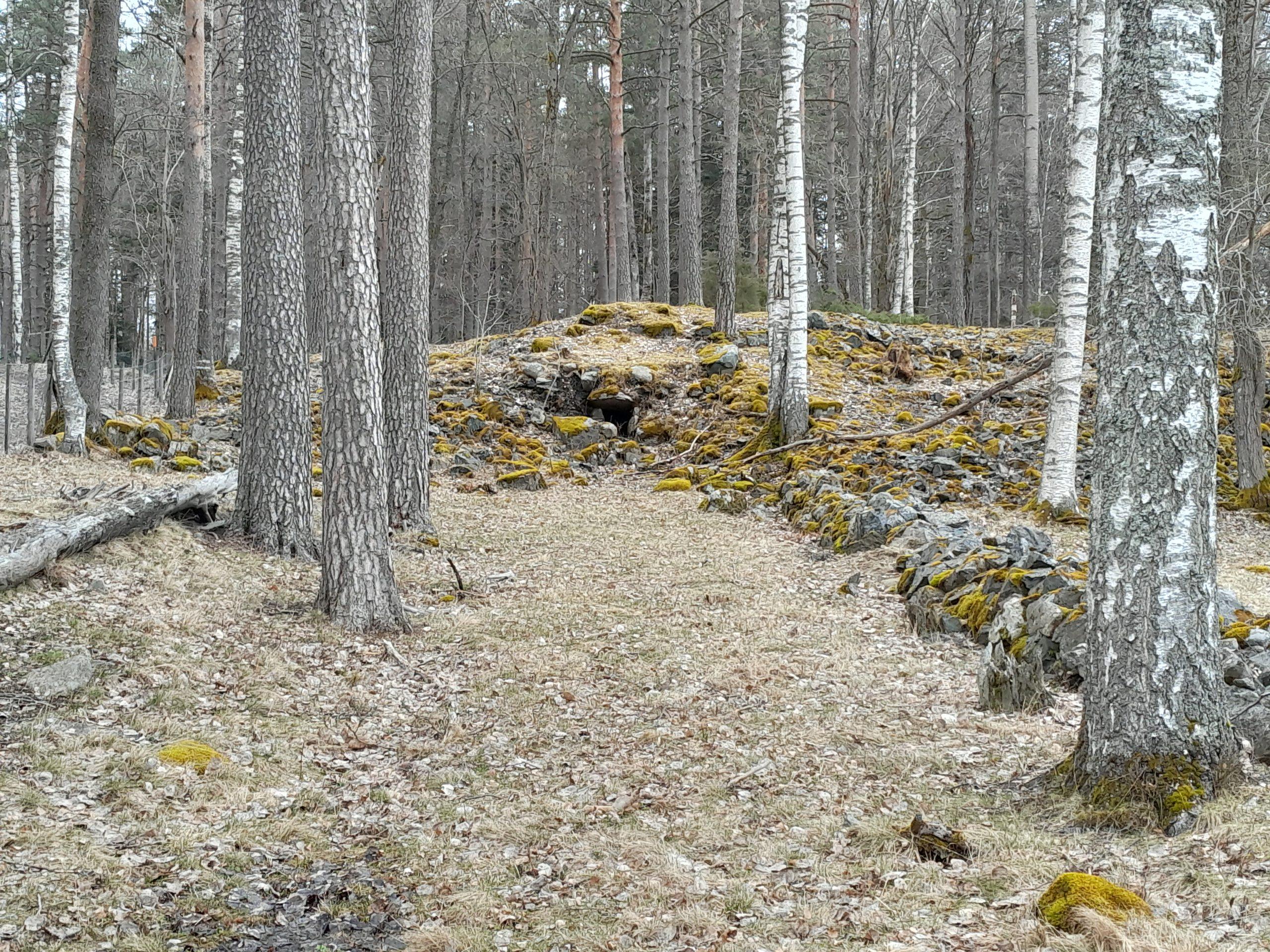
Foto: Torbjörn Nordwall.
The Ore Wharf and Chute Railway of Östra Hagegruvan
The ore from the mine was transported down to the ore wharf of Östra Hagegruvan on a narrow-gauge railway – known as a chute railway.
How the chute railway worked
The chute railway was constructed so that the loaded, descending wagon was connected to a rope. The other end of the rope was attached to a barrel hanging down inside a mine shaft. The weight of the barrel was matched to the weight of the wagon when fully loaded. When the wagon was fully loaded, the brake was released and the wagon was allowed to roll down towards the ore wharf under controlled braking.
Hauling the empty wagon back up
When the wagon had reached the wharf, the brake was applied and the ore was unloaded. Once the wagon was empty, the brake was released again, and the wagon was then pulled back up with the help of the barrel hanging in the shaft, which acted as a counterweight.
Fenced area
To prevent theft of ore, the area around the ore wharf was fenced off.
Images
6 imagesI öppning vid banans övre del gick linan, som var fäst i vagnen, in och vidare över linskivor till den lastade tunnan som hängde i schaktet.
Foto: Torbjörn Nordwall.
Lingången i riktning mot sjön.
Foto: Torbjörn Nordwall
Rutchbanans (järnvägens) sträckning, rödmarkerad. Foto från malmbryggan upp mot gruvområdet.
Foto: Torbjörn Nordwall.
Ritningen visar principen med motviktsdriften.
Arkiv: Värmlandsarkiv
Lastageplatsen för Östra Hagegruvorna. Gruvorna på Persbergshalvön hade ett mycket gynnsamt läge när det gällde transporterna av malmen, båt på sommaren och häst över isen på vintern.
Foto: Torbjörn Nordwall.
Östra Hagens utskeppningshamn.
Arkiv: Jernkontorets bildbank. Pennteckning av Johan Hall.

