Laddar...

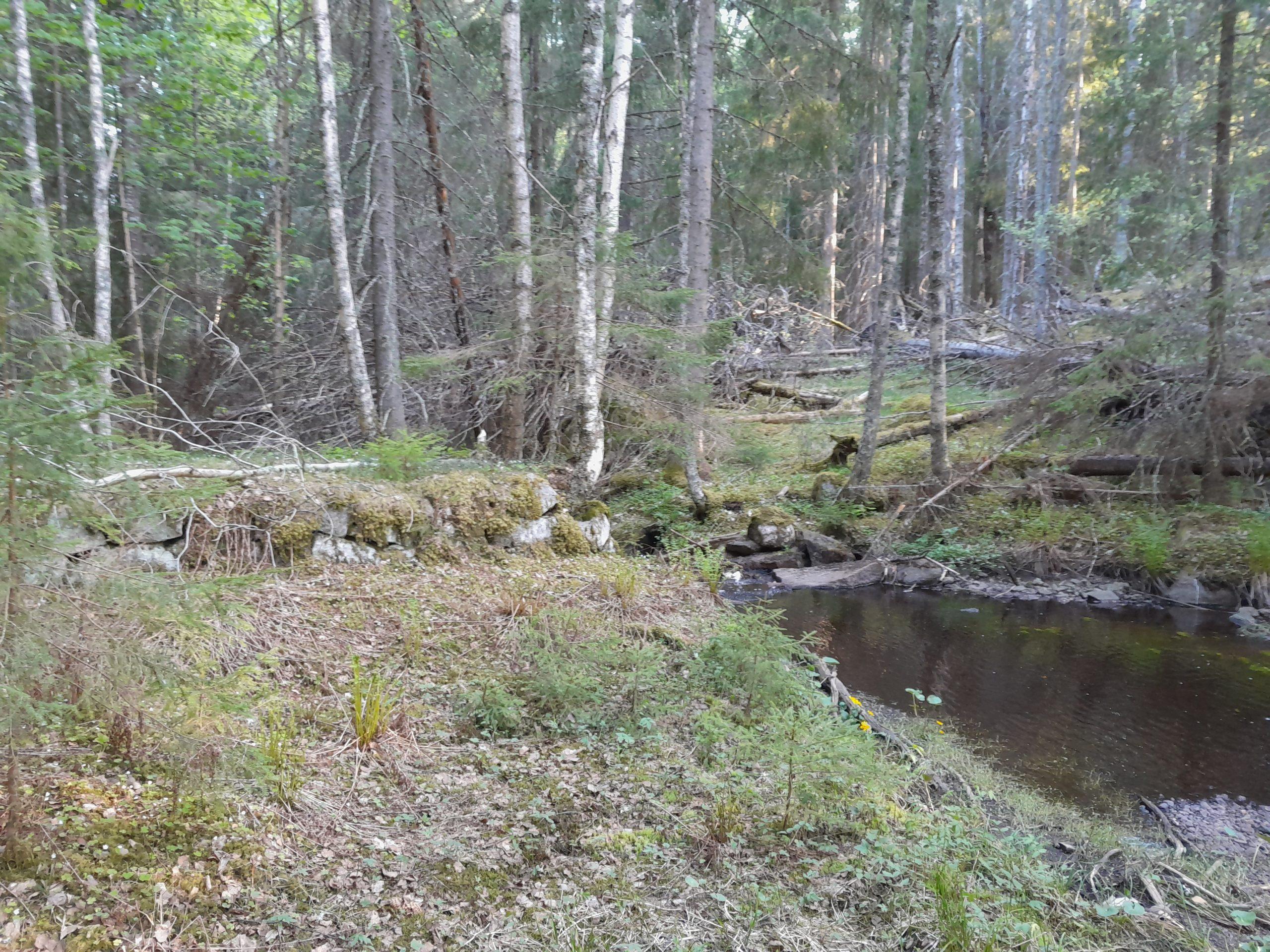
Foto: Torbjörn Nordwall
Power Transmission with Endless Ropes and Turbines
In the early 1860s, endless ropes began to be used to transmit power over long distances, using water turbines as the power source.
When the turbine at Gåsgruve Fall was replaced with an overshot waterwheel, it is likely that the head at Nyhytte Fall was utilized by digging a 200-metre-long canal and moving the turbine there.
The power supplied by the turbine was certainly very valuable at that time. If it was the turbine from Gåsgruve Fall, it had an output of 4 hp and was a Fourneyron turbine.
Benoit Fourneyron (1802–1867) invented the so-called Fourneyron turbine in 1827.
Construction of the Nyhytte Fall Facility
The exact year when the facility at Nyhytte Fall was built is unknown, probably mid-1860s, to drive the 1300-metre-long line towards Gåsgruve Fall.
The question remains whether the line continued past the fall to the mine field, or if it was connected to the waterwheel.
On the 1886 survey map of Järnvägsgruvan, a hoist line is drawn. It is possible that the Nyhytte Fall turbine supplied hoisting power, while the overshot waterwheel at Gåsgruve supplied the auxiliary power.
Importance of the Canal
Walking along the canal, one can see the immense effort invested in supplying power to the mines.
On pictures 7 and 8, drawings of the turbine facility are shown.
Follow the attached link: ”Järnvägsgruvan” for a detailed description of the line.
Images
7 imagesRödmarkeringen följer linledningens sträckning.
Historiska kartor Lantmäteriet
Dammen i Rävbäcken ligger ca: 30 m nedströms kanalintaget, ser ut att ha varit en mycket välgjord damm. WGS84 59.71193 14.23120
Foto: Torbjörn Nordwall
Kanalens väg genom stenig terräng börjar med schaktning på ca: 3 m djup,
Foto: Torbjörn Nordwall
Utloppskanalen är även den mycket välgjord, jag kunde inte se några sättningar i stensättningen. Bredden på utloppet är ca: 2,5 m, Vid kanalens slut finns inga lämningar efter nått intag.
Foto: Torbjörn Nordwall
Linans diameter ca: 20 mm. När man inte har nått skjutmått, så får man mäta så här.
Foto: Torbjörn Nordwall
Turbinen hade en 10 meter lång vertikal drivaxel som gick upp till ledningens drivhjul.
Arkiv: Wermlänska Bergsmanna-Föreningens annaler 1864 Andra häftet.
Det ca: 10 meter höga tornet med driv och stödhjul. Ritningen visar tornet vid gruvan, men konstruktionen var den samma i båda ändar av ledningen.


