Laddar...

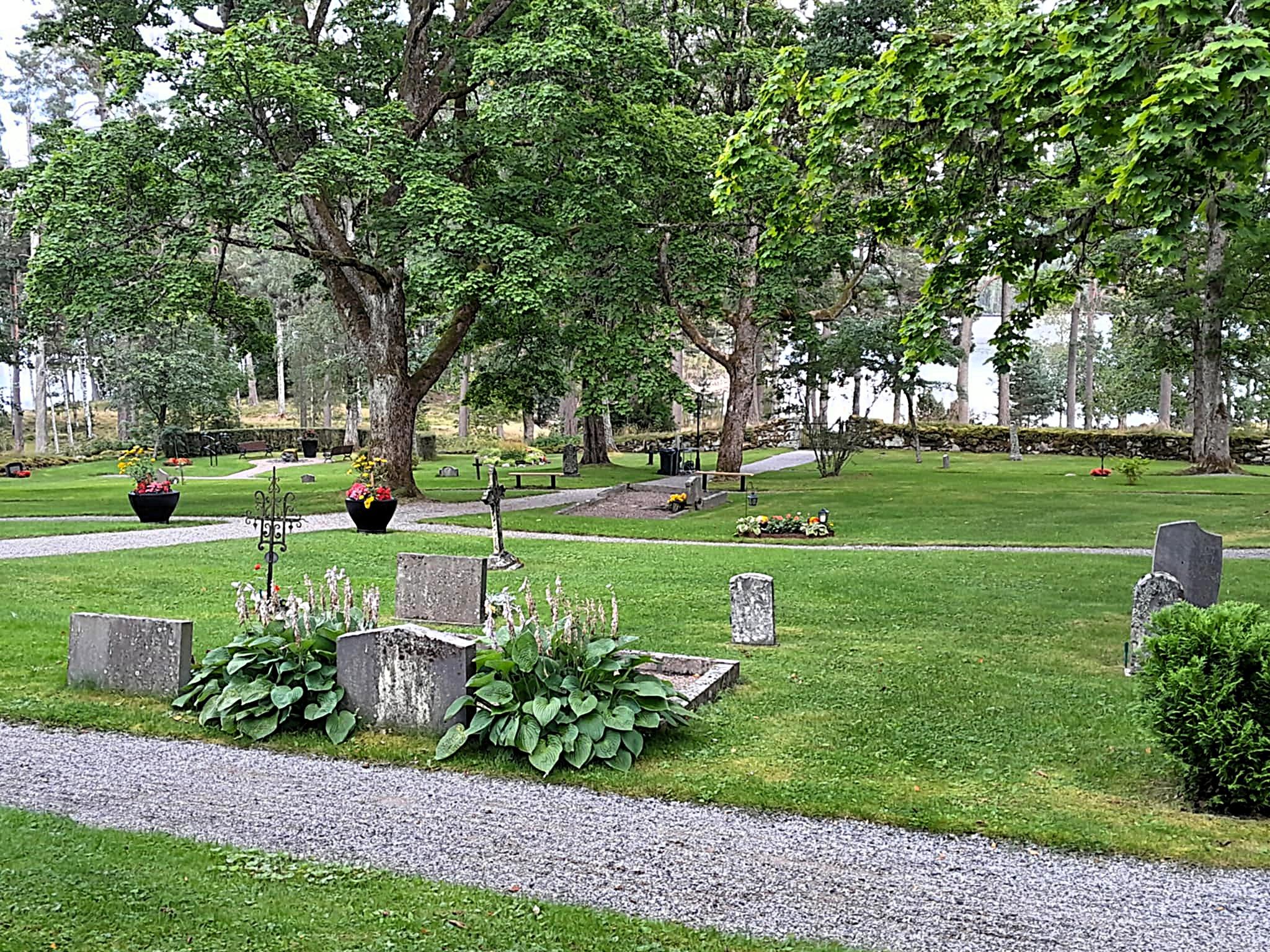
Foto: Torbjörn Nordwall
History of Skavnäset Cemetery Compiled by Eje Wigh, May 2024
The Decision on a Burial Ground (1852)
”As it would undeniably lead to a saving of costs both for the mining companies and the poorer population here, if one could avoid transporting to Filipstad the bodies of persons deceased here. The Company instructed Mr. Manager J.N.W. Uhr to make a humble petition to His Royal Majesty for the right to establish a Burial Ground beside the Prayer and School House situated here, where the aforementioned bodies may be interred by the Mine Chaplain, and Manager Uhr should in connection with this application also request the endorsement of the Right Reverend Cathedral Chapter.”
Mining Assembly Minutes, 31 July 1852, § 23
The above quotation marks the first time the burial ground in Persberg appears in writing. At the mining assembly in the summer of 1852, it was resolved to apply for permission to establish a burial ground in Persberg. Already at this occasion, the grounds of Skavnäset were considered suitable for the purpose.
The Bell Tower and the Two Triangles
At the same meeting, it was decided to procure a bell tower in the form of ”two bell angles of steel, to be used both at burials and for the announcement of divine service.”
The burial ground is reported to have been completed the following year, 1853. The assembly minutes of 8 March that year note that a ”sexton’s salary” was paid out. It is reasonable to conclude that the bell tower with its two steel angles (triangles) had also been completed by then.
No information survives regarding the original size of the burial ground, but it most likely assumed its current extent from the very beginning.
Who Was Permitted to Be Buried Here?
The burial ground was primarily intended for employees of the mines in the area. However, even before its establishment, the assembly participants agreed that others could also be interred there, upon payment of a fee of ”one Riksdaler Banco.”
Bror Billman’s Account (1924)
Old Memories of an Old Family by Bror Billman contains the following description:
”If we continue our walk to Skavnäset’s old and memorable schoolhouse, we find much here that has changed painfully. The two triangles on the hill, which once rang out to summon people to funerals and divine service, are gone and have been placed inside the schoolhouse. This building, which served as church and school for the past and present generation of Persberg, now belongs to the many premises that have become redundant, and bears the sad mark of being forgotten, with its pews, maps, exercise books and grade registers.”
It may be assumed that by ”the hill”, Billman is referring to the spot where today’s bell tower stands.
The schoolhouse and church premises mentioned are the building on the left in image 10. It was purchased in 1850 to be converted for use as a schoolhouse and teacher’s residence. At the close of 1909, teaching was moved to the newly built school down in Persberg.
Triangles in Sweden – An Unusual Phenomenon
The yearbook of the Nordic Museum and Skansen describes how people in various parts of Sweden were called to religious gatherings.
In smaller parishes, finances could be strained before the church was completed, and a church bell was a considerable expense. Where no bell was available, other solutions had to be found:
- At Värskär’s fishing chapel, a divine service drum was used.
- In other places, a horn was blown.
- In the village of Ås in Jämtland, the ”sexton” went out onto the churchyard hill and called the congregation in by voice.
According to the yearbook, there are only 13 places in Sweden where it has been established that triangles were used to summon people to religious gatherings. Persberg is one of them.
Only three triangles are preserved in the country:
- two in museums
- one at a local heritage farm
This means that the triangle preserved in Persberg is the fourth in the country, making it exceptionally unique.
The Return of the Triangle
Warm thanks are extended to the Sandvall family at Persberg Manor, who donated the triangle to the Local Heritage Association ”Vi i Persbergsbygden” (We in the Persberg District).
The triangle was rededicated on Högbergsfältets Day on 20 May 2023 at Skavnäset Chapel. It is now displayed at the community centre Yngsvallen.
Images
10 imagesKapellet byggdes år 1943-44 efter ritningar av Einar Lundberg, på initiativ av Persbergs Kyrkliga syförening.
Foto: Torbjörn Nordwall
Kapellets lilla kyrkorum. Altartavlan är skapad av Karin Fryxell
Foto: Kjell-Arne Adolphzon
Psalm 248: ”Tryggare kan ingen vara” av Lina Sandell ca: 1850.
Psalm 386: ” Upp ur vilda, djupa vatten” Svensk bearbetning av Britt G. Hallqvist. Modern doppsalm.
Foto: Kjell-Arne Adolphzon
I Skavnäsets kapell finns Filipstads församlings minsta orgel, den är helmekanisk och är byggd av Anders Perssons orgelbyggeri Nyhamnsläge omkr 1980
Foto: Torbjörn Nordwall
Kyrkogården ligger vackert vid Yngens strand, den tillhör Filipstads församling i Karlstads stift.
Foto: Torbjörn Nordwall
”Likboden” uppfördes år 1857, innan kapellet byggdes hölls begravningar i boden.
Foto: Torbjörn Nordwall
Den i texten beskrivna triangeln, den återinvigdes vid Skavnäset i samband med Högbergsfältets dag den 20/5 – 23.
Foto: Torbjörn Nordwall
Den här keramikkrukan användes vid Persbergs sprängämnesfabrik, i keramikkrukor förvarades de i nitroglycerintillverkningen ingående syrorna, salpeter o svavelsyra.
Foto: Tobias Nordwall.
Den till kyrkogården hörande klockstapeln är placerad ca: 250 m i sydvästlig riktning från kyrkogården.
Foto: Evalena Lindstedt.
Huset till vänster är det skolhus som Bror Billman nämner i texten ovan och som användes för kyrkliga sammankomster .
Arkiv: Filipstads Gilles bildarkiv.