Laddar...
 Technology
Smithy, Sawmill and Power Station
- Coordinates:
- 59.74909, 14.26141 (WGS84) (opens in new tab)
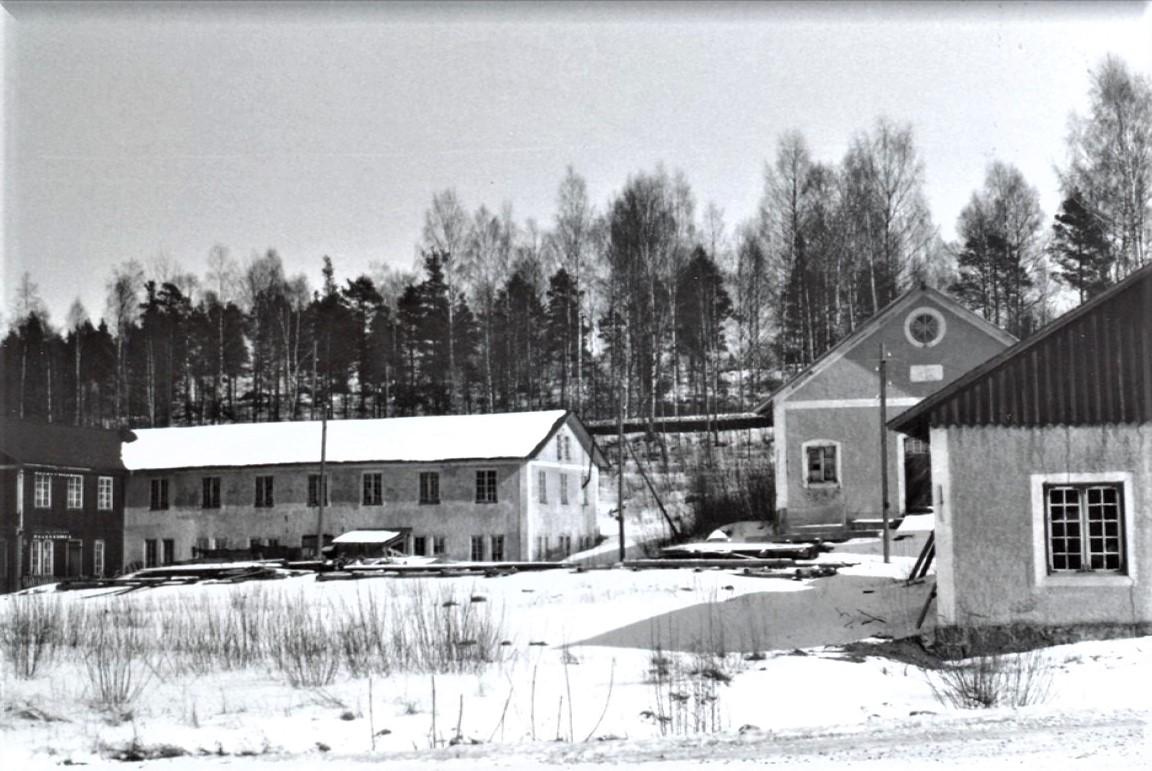
The Sawmill at Sågfallet
In the early 1860s, the sawmill was moved about 1.5 km downstream to Malmbergsviken from the place still known today as Sågfallet. The relocation made it easier to transport timber to the mill, since most of the logs were floated by water from forests around the lake.
Early Electric Lighting
As early as 1890, the manager Mossberg installed a dynamo machine at the sawmill. It was driven by the sawmill’s turbine and supplied electric lighting to selected locations within the mining area.
Most of the power lines consisted of old mine cables. According to Hjalmar Södersten, foreman of the electrical department at the mines, the generator also supplied lighting to the Manor House.
In Jernkontorets Annals (1892) it was noted that strong electric lighting for mining work had so far only been used at Persberg and Grängesberg.
Reconstruction of the Sawmill
Drawings shown in images 7, 8 and 9 illustrate a proposed reconstruction of the sawmill in 1906. The reconstruction was probably carried out, as the book “Forestry in Värmland – Past and Present” (1929) states that the sawmill contained one frame saw for local sawing needs.
Forestry and Sawmill Production
Between 1908 and 1922, an average of 4,600 m³ of timber was harvested annually on company land, about half of which was used for the mines and company properties.
The sawmill was described as an electrically powered installation with a frame saw, a double edging saw and a planer, located below the Krangruvan mine at Malmbergsviken, close to the railway.
The Sågfallet Power Station
In 1924, a 160 horsepower double turbine from Finnshyttan was installed in the old smithy. It was connected to the intake pipe of the hydraulic compressor through a branch pipe.
The pipe leading to the turbine was drawn through the former sawmill intake, which had become dry after the Krangruvan waterwheel was taken out of operation.
Under normal operation, the station produced approximately 80 kW.
Technical data
Owner: Persbergs Grufve AB
- Built: 1924–1925, 1928
- Catchment area: 40 km²
- Water flow used: 0.6 m³/s
- Turbine: 1 Francis turbine, 2 runners, 160 hp
- Generator: 3-phase, 50 Hz, 2000 V, 175 kW
- Peak load in 1929: 90 kW
- Production in 1929: 161,190 kWh
Data from “Sweden’s Developed Hydropower 1930”, published by the National Board of Trade.
The Smithy and Workshop
In 1864, a smithy and workshop were built at Sågfallet.
However, the facility was equipped with rather primitive tools and machinery, and it soon became insufficient for the technological development of the mines.
Therefore, in 1917, the company constructed a new repair workshop and smithy better suited to modern requirements.
Drawings of the 1864 smithy and workshop are shown in images 5 and 6.
Images
10 imagesSågen flyttades ner till Malmbergsviken vid omregleringen på 1860-talet.
Foto: Okänd
Intaget för såg och verkstad.
Foto: Torbjörn Nordwall
Bild 3. Murningen i sinnerväggen märkt 1, där kom tuben in till turbin som drev såg och verkstad. Tub märkt 2, den tuben försåg kraftstationens turbin med vatten.
Foto: Torbjörn Nordwall
Bild 4. Avgreningen för kraftstationen som var ansluten mot tuben till hydrauliska kompressorn.
Foto: Torbjörn Nordwall
Mek verkstad på nedre våningen, på andravåningen var det snickarverkstad.
Ritning: Tekniska museet
Såg och snickarverkstad.
Ritning: Tekniska museet
Arkiv: Värmlandsarkiv.
Arkiv: Värmlandsarkiv.
Arkiv: Värmlandsarkiv.
Sågen eldades ner år 1970.
Foto: Okänd.