Laddar...

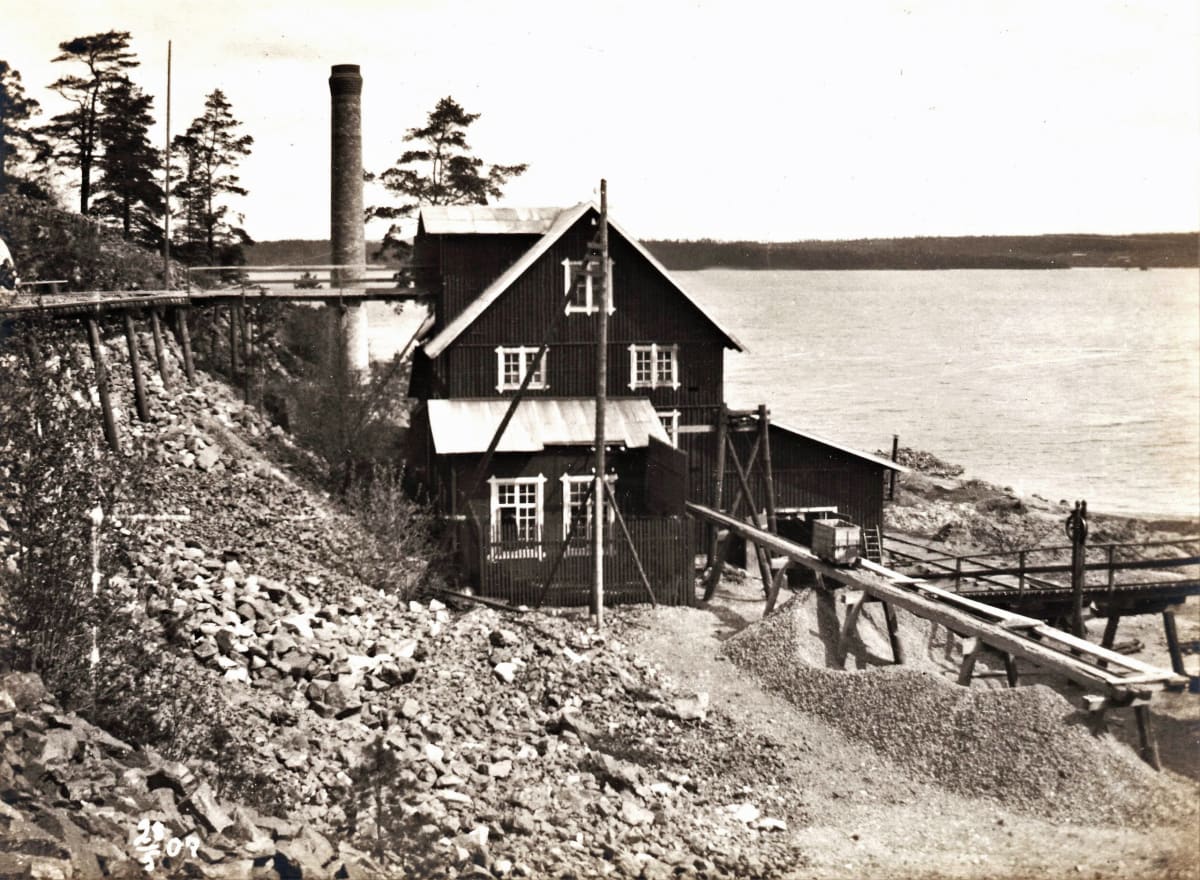
Photo: Mining Engineer Gunnar Aasgaard
The ore processing plant at Högberget was built after the auditors noted in 1899 that the company’s ore reserves needed to be increased. No new deposits could be found at the time, and it was therefore proposed to make use of the large waste rock heaps at the mine fields.
On 1 December 1899, the company assembly resolved to present a proposal for a steam-powered processing plant. The very next day the proposal was adopted and 70,000 kronor was granted for its construction.
On 29 June 1900, engineer John Andersson was commissioned to erect the plant north of the railway.
Operation and Production
The plant was not run during the winter months and was usually in operation 9 months per year, with 10-hour shifts per day.
Between 1901 and 1908, a total of 46,854.3 tonnes of raw material passed through the plant.
Below images 8–12 (on your page) there are factual details about the operation as well as accounts of the ”mineralogical and petrographical nature of the waste rock heaps at the Högberg field”.
Expansion and Relocation
Production did not meet expectations, and already in 1902 the plant was expanded. To increase profitability, waste rock from the Odal field also began to be processed.
Transport costs from there were, however, high. When in addition the waste rock at Högberget began to run out, the board resolved in 1908 to relocate the processing plant to the newly built separation plant at the Odal field.
Steam Power or Electricity?
The auditors had early reservations about the choice of steam power, citing uncertain and rising coal prices.
Engineer C.J. Nilsson in Blombacka was therefore commissioned to investigate whether water power could suffice for the operation. The investigation showed, however, that sufficient water power was not available.
It was therefore decided to purchase a 55 horsepower steam engine from Munktells Mechanical Workshop in Eskilstuna.
The auditors continued nonetheless to advocate the advantage of ”abundant power, supplied by electrical means”. Already in 1900, C.J. Nilsson was commissioned to investigate the possibility of obtaining electrical power from the waterfalls at Saxån, but this was not considered feasible at the time.
In 1903 a new investigation was carried out which showed that deliveries should be possible from the Älvestorp power station. A contract was drawn up for the supply of 300 horsepower for the period 1905–1930.
Sources
- Commemorative publication: Persbergs Gruve Aktiebolag 1866–1920
- Harald Carlborg, Persbergs Malmtrakt
- C.J. Nilsson’s investigation (Värmlandsarkiv)
Gunnar Aasgaard
Gunnar Aasgaard was a Norwegian mining engineer who made study trips to Sweden in 1907 and 1915.
The photograph you mention came to you via Jan Kruse and his contact in Trondheim, Rune Moseng – and there is undeniably something special about a photograph finding its way ”home” to Persberg again after 117 years.
Technical information
This concentration plant, built in the years 1900–1902, is located at the Högberg mining field on the shore of Lake Yngen. It was intended for the processing of old waste rock dumps, primarily at the Högberg field but also at other mines in the Persberg area.
Initially the plant was equipped with one Gates crusher, one ball mill and one magnetic separator of the Gröndal type No. 1. During the latter half of 1902 another set of these machines was installed.
Treatment of raw material
The raw material, which outside the plant is subjected to a coarse manual sorting, is transported by rail to the upper level of the plant and fed directly into the crusher.
The raw material processed at the plant is estimated to contain 15–20% iron. In 1901 the process yielded 23% concentrate and in 1902 about 19%, containing roughly 57% iron.
The waste produced in the process generally contains 2–4% magnetite.
Production capacity
The plant has processed on average 25–30 tons of raw ore per 24 hours.
For its operation eight workers per shift were required, including the engineer and the fireman.
Power for the plant is supplied by a steam engine of 55 horsepower.
The water consumption is approximately 200 litres per minute.
Machinery
Gates crushers are used for crushing the raw material from about 150 mm down to 50 mm grain size.
They operate at about 75 strokes per minute and require about 6 horsepower each.
The ball mills are equipped with cylindrical open screens with a hole diameter of 5 mm.
They contain 110 chilled iron balls with an original weight of 10–12 kg each and rotate at about 25 revolutions per minute.
Operation and wear
During the years 1901 and 1902, when 8,348 tons of material were processed, balls with a total weight of about 9.5 tons were consumed, corresponding to about 1.14 kg of grinding balls per ton of raw ore.
During the same period the mill lining plates and grates were worn out twice.
Magnetic separators
The magnetic separators operate at a current of about 5–7 amperes at approximately 30 volts.
The separator itself rotates at about 24 revolutions per minute and the scraper at 180–190 revolutions per minute.


