Laddar...

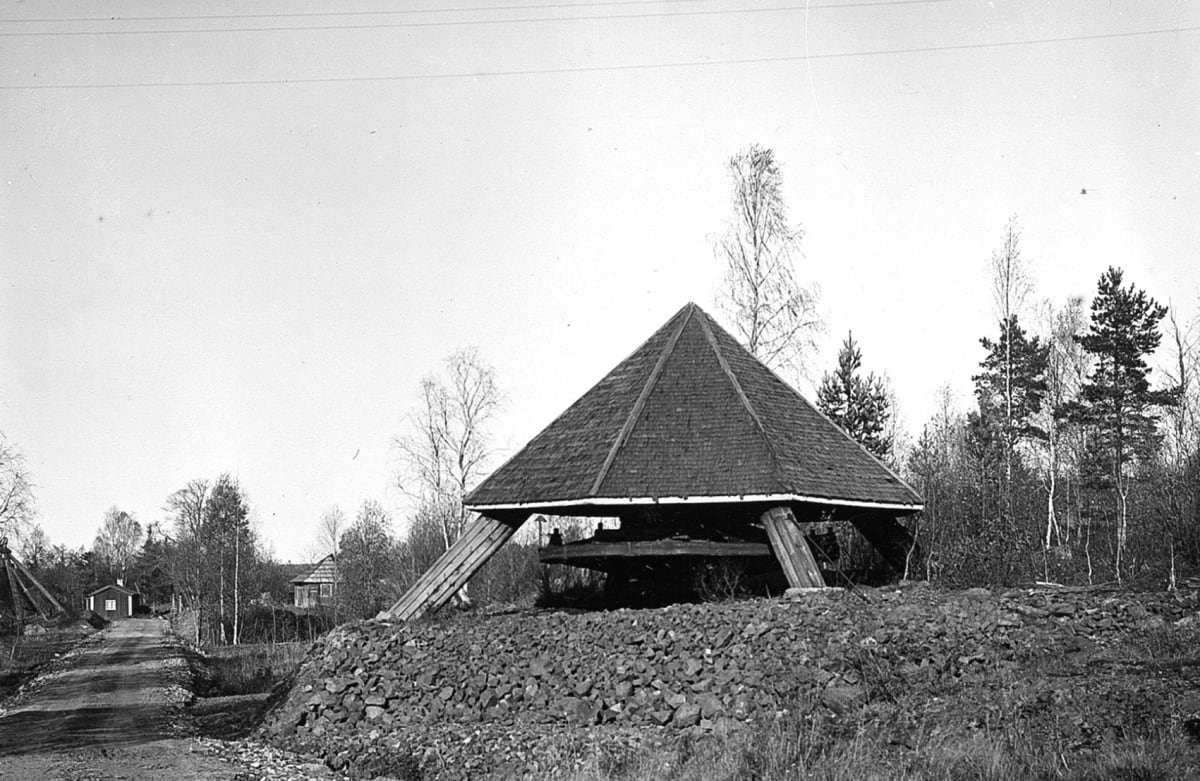
The reversing crank near the headframe belonged to the pumping rod system of the Gustav Adolf Mine. It is the only surviving crank structure from the once extensive system of pumping rod lines that supplied the mines of Persberg with mechanical power.
Mine Drainage at Persberg
From 1752 onwards, water-powered pumping rod systems were primarily used for mine drainage at the Persberg mines. At mines where water power could not be utilized, horse-powered pumping systems as well as horse or hand-operated windlasses were used instead.
Function of the Rod System
The rod system was used to transmit power from the waterwheel at the waterfall to the mines. The power was transferred by wooden rods attached to the crankshaft of the waterwheel, moving back and forth.
Along the route to the mine, it was often necessary to change the direction of the rod system both horizontally and vertically. This was achieved using so-called reversing cranks (examples of their construction are shown in images 2, 3 and 4).
Power Transmission in the Mine
At the mine, the rods were connected to a device known as a “dopper” or angle lever. This mechanism converted the horizontal motion into vertical motion.
The rods attached to the dopper and extending down toward the bottom of the mine were called main rods. The pump rods were attached to these, one for each pump installation.
If the water inflow was limited, sometimes only a single main rod was used.
Pumping Rod Systems at Persberg in 1818
In 1818 the following rod systems existed in the Persberg mining area:
-
Storgruvan (Great Mine) – 1490 m, 8 crank stations
-
Braske and Torskbäck Mines – 2982 m, 10 crank stations
-
Hag Mine – 2385 m, 14 crank stations
-
Malmbergskärr – 836 m, 4 crank stations
In total there were 7,694 metres of rod systems and 36 crank stations in operation before the Persberg Canal was built in 1820.
Maintenance
Maintenance costs were considerable, as the wooden components of the pumping systems decayed and had to be replaced approximately every ten years.
The Final Waterwheel
The waterwheel at the Gustav Adolf Mine was built in 1900 and remained in operation until 1916. It was the last pumping waterwheel used at the Persberg mines.
When the wheel was stopped in 1916, a 164-year era came to an end. The first waterwheel had been built in 1752 in the Yngshytte River at Gubbdammen.


