Laddar...

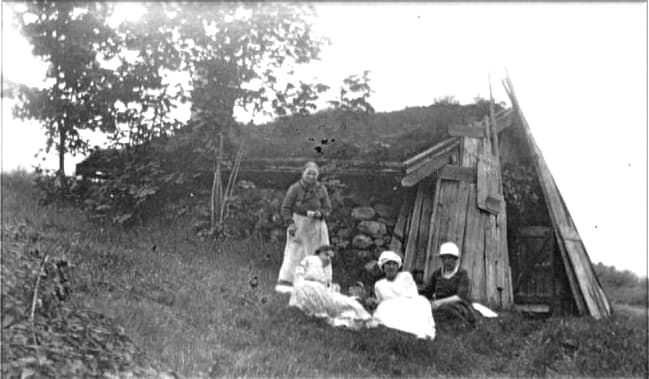
Bush Lina at her dugout.
Housing for the Mine Workers
Right up until the mid-19th century, workers largely had to find their own accommodation by building an earth hut on or beside the mine field. The location was preferably chosen to allow for cultivation, and potatoes and cabbage were common crops at the mine fields.
Until the end of the 19th century, the earth hut was the type of dwelling that the less well-off members of society had to make do with. The homes were often very small, and sometimes entire families lived in just a few square metres. When walking across the Högberg field today, one can still see the remains of numerous earth huts of varying sizes.
Construction and Interior
Earth huts varied in their design:
- The simplest type: Built from discarded stone from the mining operations (known as waste rock).
- More advanced types: Dry-stone walls of natural stone, covered with moss and sometimes birch bark before backfilling with earth.
- The front was often made of timber with a door and sometimes a small window.
- The floor was of compacted earth and the roof of round timber, insulated with moss, bark and turf.
Initially the dwelling was heated by a simple hearth in the middle of the hut with a smoke hole in the roof, similar to the Finnish smoke cottage. Later, fireplaces with chimneys were built, constructed from natural stone and clay.
Life in the Earth Hut
- The earth hut came with no land, but those who could afford it might keep a goat, which provided an important supply of milk.
- During winter, one might need to share the living space with the goat.
For long periods, Sweden’s population lived a poor, harsh and short life. During the latter part of the 18th century, the average life expectancy for women was only 37 years, slightly lower for men. High infant mortality contributed to the low average age, but children who survived their first five years could often live to around 50.
Regulation and Change
In 1850, doctors and authorities began to draw attention to the unhealthy living conditions that earth huts offered.
- In 1870 the Health Act was introduced, which regulated housing health and hygiene.
- Despite this, many earth huts were probably not deemed unsuitable as dwellings.
The Stor- and Krang mine companies established mine labourer cottages in 1858, but long before this the workers themselves had built smallholdings on the mine slopes.
- In 1786 there were 23 dwellings and cottages belonging to mine workers on the Nygruvan and Högberg ore fields, in addition to those belonging to the householders.
Later Times
In the western part of Persberg, an old woman known as Busk-Lina continued to live in her earth hut until the early 1930s.

