Laddar...
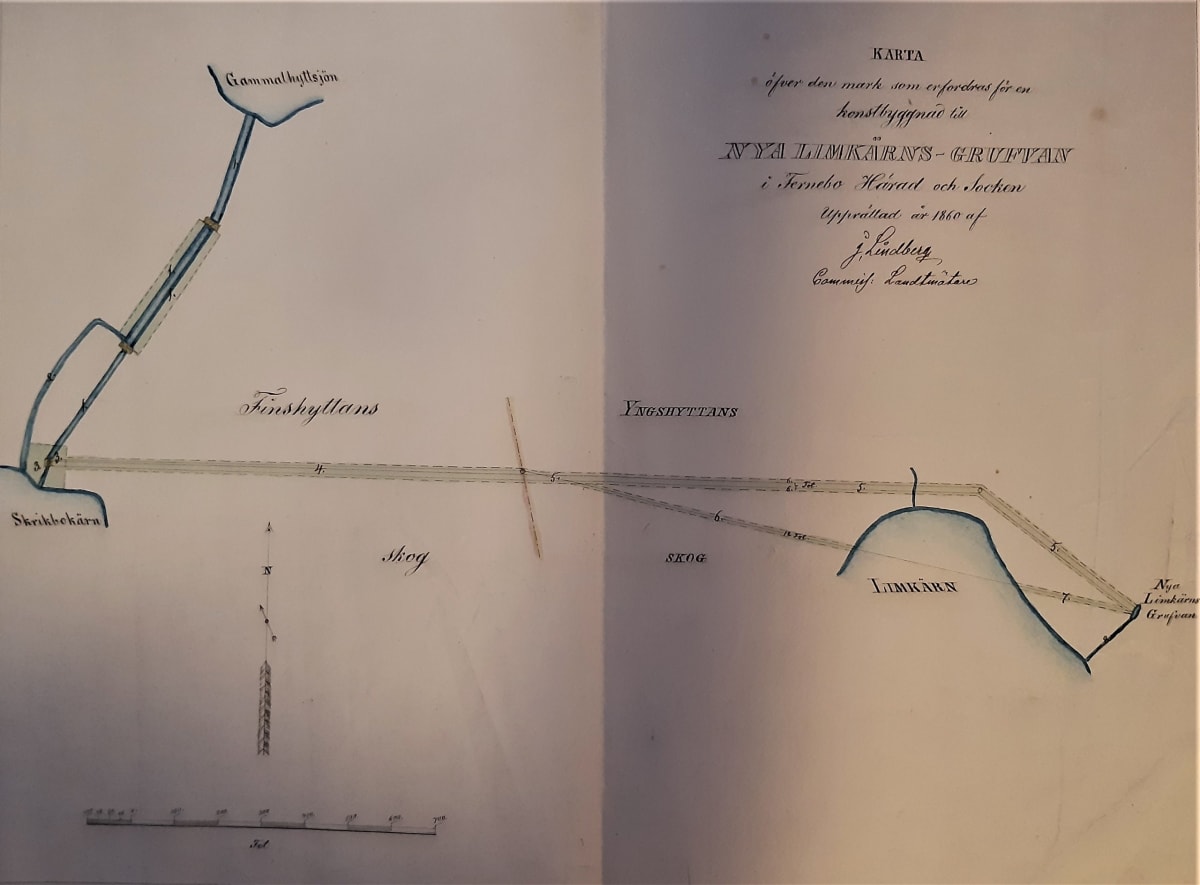
Konst o Spel vid Skribotjärn.
 Waterwheel
Coordinates: 59.74672, 14.18954 (WGS84)
Fallhöjd: Ca: 25 m.
Konsternas längd: Ca. 2500 meter.
Den försåg flertalet gruvor med konst eller spelkraft:
Skribogruvan, Kankagruvan, Getbergsgruvan, Nya Limkärnsgruvan,
Nyårsgruvan, Limkärnsgruvan och Mörkhultsgruvan.
Konsternas längd: Ca. 2500 meter.
Den försåg flertalet gruvor med konst eller spelkraft:
Skribogruvan, Kankagruvan, Getbergsgruvan, Nya Limkärnsgruvan,
Nyårsgruvan, Limkärnsgruvan och Mörkhultsgruvan.
Fallhöjd: Ca: 25 m.
Konsternas längd: Ca. 2500 meter.
Den försåg flertalet gruvor med konst eller spelkraft:
Skribogruvan, Kankagruvan, Getbergsgruvan, Nya Limkärnsgruvan,
Nyårsgruvan, Limkärnsgruvan och Mörkhultsgruvan.
Konsternas längd: Ca. 2500 meter.
Den försåg flertalet gruvor med konst eller spelkraft:
Skribogruvan, Kankagruvan, Getbergsgruvan, Nya Limkärnsgruvan,
Nyårsgruvan, Limkärnsgruvan och Mörkhultsgruvan.
Power and hoist system for Limkärns Mines
Constructed in 1860 by C. A. Ångström, who used a turbine as a power source for both the hoist (“spel”) and the mechanical works (“konst”). Since the mechanical works operated most of the day, the hoist had to be usable without affecting the operation of the mechanical works. Ångström used wedge wheels instead of the commonly used clock couplings to engage the hoist. This design allowed the hoist to start smoothly, without jolts and without disturbing the mechanical works. The ore barrel descended into the mine under its own weight, and its speed was regulated with a brake on the pulley frame. A detailed description of the construction and the functioning of the wedge wheels can be found under “texts.”
In 1862, the turbine was partially rebuilt. L. M. Larsson wrote in his annual report:
”A drawing was prepared and a cast iron reservoir installed for the mechanical and hoist turbine at Limkärns Mine, as the previous wooden one had become leaky due to high water pressure.”
In 1873, the existing hoist was rebuilt. Unfortunately, there are no records of the details of this reconstruction. In the same year, a ca. 100-meter-long hoist line was built to the Getbergs Mine.
Power Station
On the same site where the mechanical and hoist house had previously been located at Skribotjärn, a power station was built in the 1920s (?) with a capacity of 20 kVA (De Värmländska järnbruken, Jalmar Furuskog 1924), supplying parts of the Finnshyttan works. Today, only the turbine remains in the power station building, probably manufactured by Finnshyttan.

