Laddar...

Road Mines
Introduction
Regarding the mines on Tallnäset, the information about the mines’ names is somewhat confusing. I have compared the information in the reports, Persbergs Malmtrakt, and studied several maps to draw my own conclusions about the correct names of the mines.
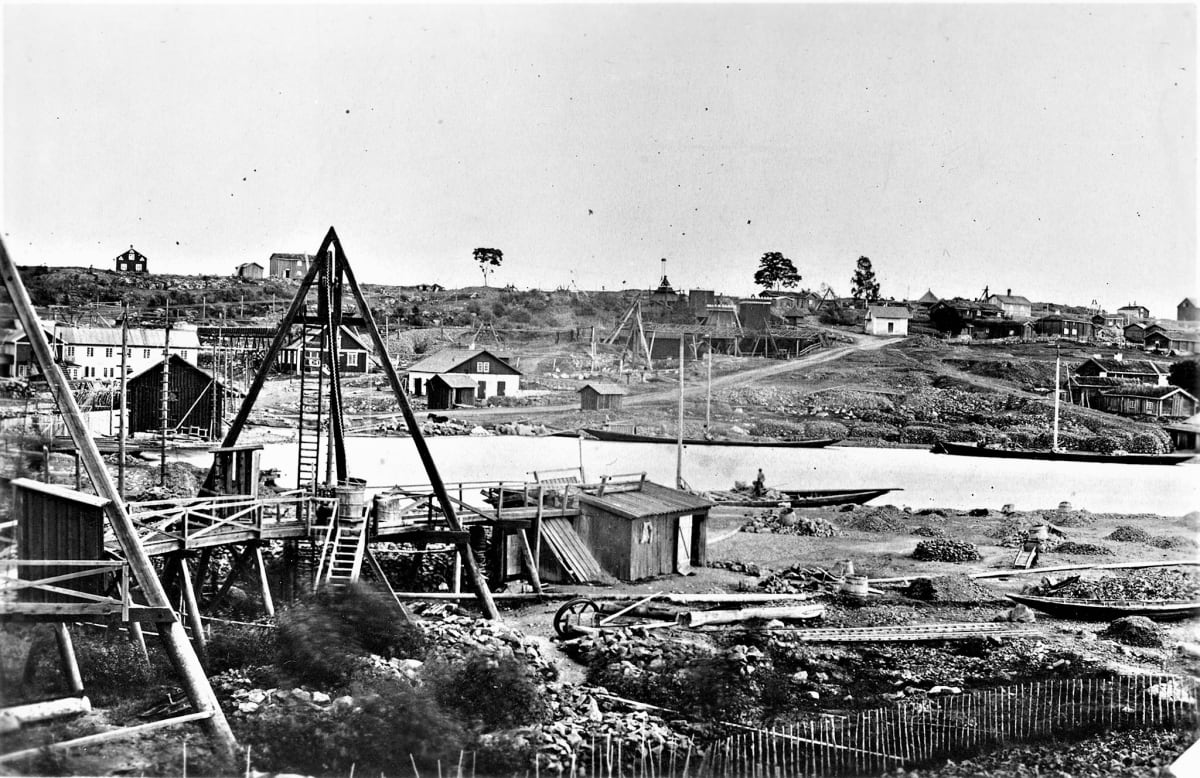
Picture 2 shows a view over Malmbergsviken, a very interesting photo that displays both lake transportation and mining activity.
In the foreground, the two mine shafts of the Lower Road Mine (Nedre Väggruvan) are visible. Behind the right shaft, Krangruvan’s hoist house can be seen, from which the Lower Road Mine received its hoisting power for lifting ore from the mine.
Krangruvan’s hoist house was built in 1863, and in 1881 the wooden house was completely destroyed by fire. The mechanical power for the mine came from Krangruvan’s water wheel.
Road Mine (formerly Eastern Tallnäs Mine)
-
According to the reports, it was mined already before 1791 when it was re-opened from abandoned status, with a depth of approximately 12.5 meters.
-
Also mined during the years 1829–30.
-
The reason I believe it was called Eastern Tallnäs Mine is that it previously, according to Nils H. Magnusson in Persbergs Malmtrakt page 190, lay within the Eastern Tallnäs Mine’s claim area.
-
On the attached claim map (Picture 4) from 1854, the claim had changed its name to the Road Mine claim.
Upper and Lower Väg Mines, history
Under the name Upper and Lower Väg Mines, two new mines were opened in 1855 within the mining claim of the Väg Mine. It is likely that these were the mines that Olof Bergström staked a claim to in 1854, as he lived nearby. If you follow the attached link, you can read about how Olof’s wife Katarina discovered the ore deposits and, on her own and without Olof’s knowledge, began extracting ore. The author Åke Hasselblad describes the discovery in an imaginative way. There the mines discovered by Katarina are referred to as the Lake and Väg Mines.
Upper Road Mine (Övre Väggruvan)
-
According to the reports, the Upper Road Mine lies only a few fathoms east of the abandoned Little Tallnäs Mine, but the Little Tallnäs Mine is approximately 120 meters further west, so it is the Road Mine meant, which had been abandoned for 25 years.
-
1855: In a new excavation, the remaining roof ore of the old mine was mined in the hanging gable, and after approximately 11 meters, a connection with the old mine was made and a water wheel installed.
-
1856: The old mine’s bottom was cleaned, and the water wheel and pipe system were extended to the mine bottom.
-
1858: Work was suspended in January.
-
1854: Stakeholders in the Eastern Tallnäs Mine (Upper and Lower Road Mine) applied to build a water wheel at Pumpafallet. They were granted permission to build the wheel at the approximately 2.5-meter-high fall and a 610-meter-long water race down to the Lower Road Mine.
-
Observations: No traces of the wheel pit at the fall remain; only remnants of a pipe system on the western side of the canal bank. No map shows the water race from Pumpafallet to the Road Mine, but a map from 1863 shows a water race coming from the east, probably from Krangruvan’s new water wheel.
Lower Road Mine (Nedre Väggruvan)
-
Location: Approximately 54 meters southeast of the Upper Road Mine, a few meters west of the recycling station at Malmbergsviken.
-
1855: ”After minor earth clearing, ore approximately one fathom wide was encountered. An excavation was made, and when the excavation became deep enough to go underneath, it was driven southeast, where the ore continued to show better, so that the mine now has a length of 10 and a width of 1 ½ to 2 fathoms.” (From the reports.)
-
1856: Under the name ‘Middle Mine’ (Mellangruvan), an earth clearing was made northwest of the lower mine. Upon reaching the rock, a narrow ore vein was found, but no real mining occurred.
-
1860: A shaft was driven northwest of the lower mine’s surface opening to provide a ”more convenient” hoisting system. The shaft connected with the underlying gallery in 1862. The earth clearing for Middle Mine likely influenced the shaft location.
-
1867: The mine now has a length of approximately 89 meters and a depth of approximately 65 meters.
-
1870: Mining ceased this year after ore availability and profitability had decreased in recent years.


