Laddar...

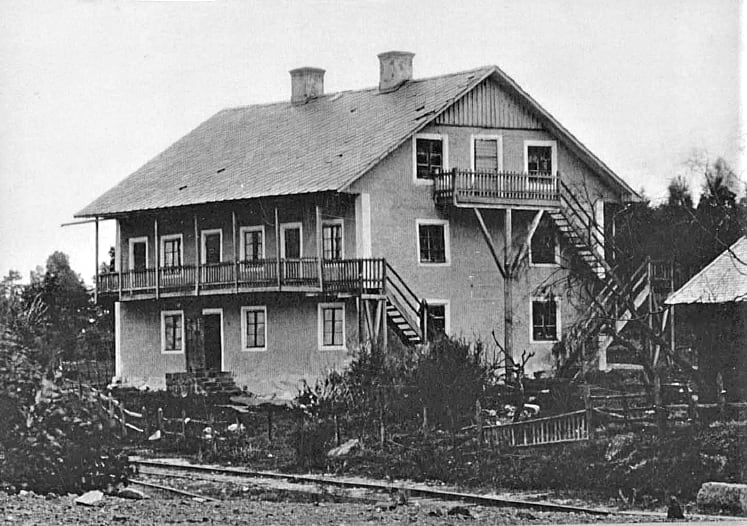
Dahlgren’s Building
Dahlgren’s building was probably constructed in the mid-19th century as housing for the workers of the Högberg mining field. It was built using “sinter stone,” also known as “Bergslagen stone” or “slag brick,” and had plastered walls.
It is difficult to form a clear picture of the layout of the first floor, but the second floor most likely contained six one-room apartments.
As can be seen in image 1, the building had external staircases, which makes the layout of the third floor appear quite unusual today.
Regarding the third floor, Hacke Juvel recounts the following: it contained two gable apartments, and to reach the southern apartment one had to pass through the neighbor’s apartment to the north. Good relations between neighbors were therefore essential.
Slag as a Building Material
Slag was formed during the production of iron in blast furnaces, and large quantities were generated, especially at the larger ironworks.
The slag floated on top of the molten iron in the furnace and was tapped out onto the floor of the smelting house, where it was broken up by hand and transported to storage areas.
Slag was used as an inexpensive building material, known as slag aggregate, and it was sometimes even used for roofing.
The slag aggregate was sometimes laid in bond with lime mortar, but a common method was to use molds to form walls using a mixture of lime mortar and slag fragments.
The walls were plastered both externally and internally with lime mortar to protect against moisture penetration.
It was only when the technique of casting slag bricks had been mastered that slag gained value for the ironworks—previously it had merely been a labor-intensive waste product.
The Development of Slag Bricks
The idea of casting building materials from slag came to Sweden from England. During travels to England in the 1740s, the architect Clas Eliander observed how slag stone was cast for construction purposes.
Axel Fredrik Cronstedt, mining inspector of the eastern and western Bergslagen districts, began experiments in casting slag bricks, but it proved difficult to produce a durable material.
He concluded that ores smelted without the need for added limestone were best suited for casting bricks.
He also realized that the size of the added limestone was the main problem. If the stones were too large, they did not fully dissolve in the melt and instead absorbed moisture, making the bricks brittle and sensitive to frost.
When he began finely crushing the limestone so that it dissolved properly in the melt, the problem was solved and production could begin.
Only slag from charcoal-fired blast furnaces could be used for casting slag bricks.
Buildings made from slag bricks were initially plastered, but by the late 19th century it became fashionable to leave the aesthetically appealing masonry exposed.
Source
Article: Enchanted by the Building Stone of Bergslagen by Martin Sjöström, Building Conservation Program, Uppsala University – Campus Gotland, Spring Term 2022.


