Laddar...

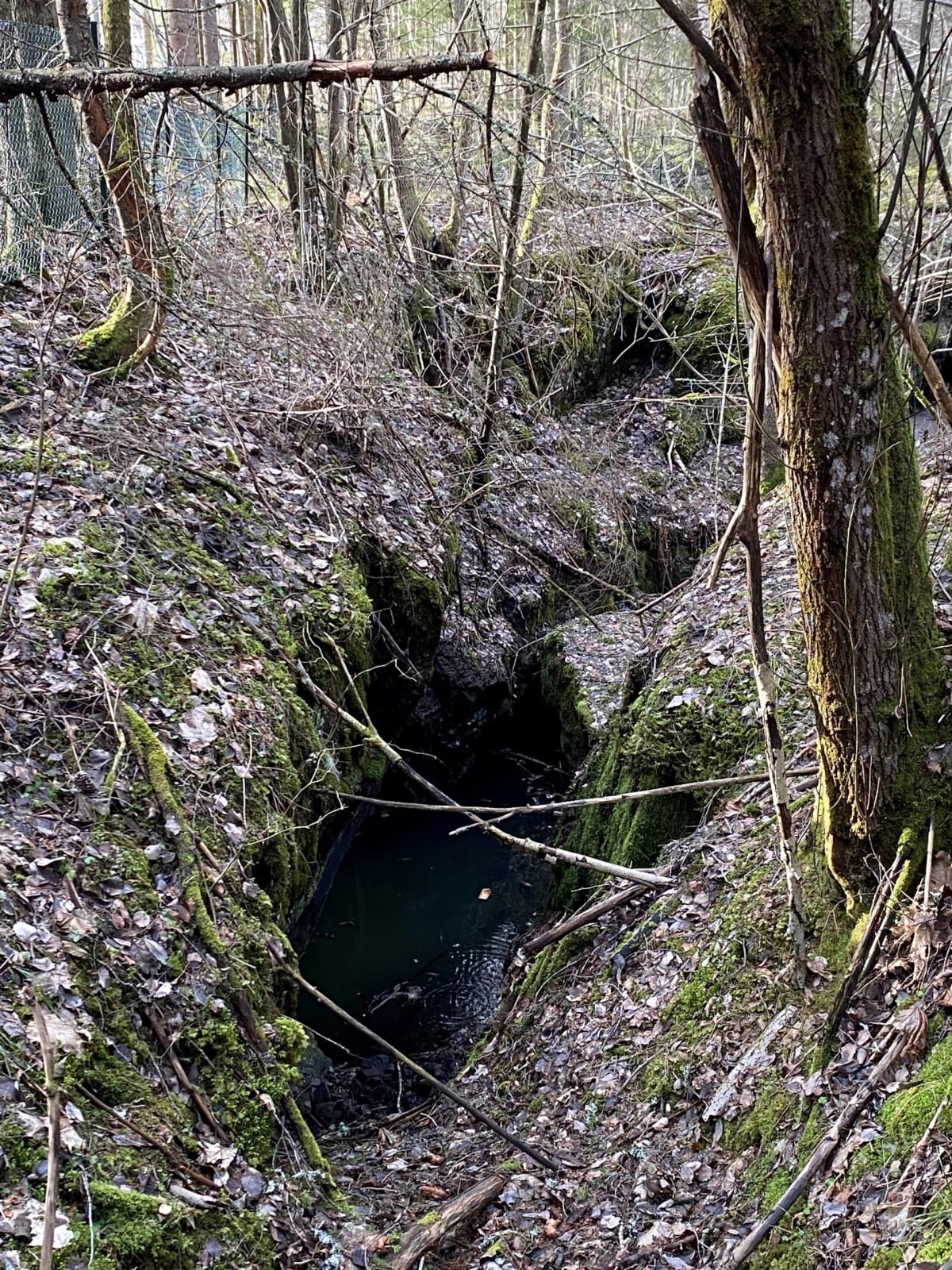
The Harstig Mine
The Pajsberg mining field includes, in addition to the Hastig Mine, within the claim of the Harstig Mine, the Flaks Mine, Björk Mine, Olov Jans Mine, Jon Jans Mine and the Pajsberg Mine, all within the claim of the Pajsberg Mine.
Claim of the Harstig Mine
The mining claim was established on 13 November 1917, and the owner of the claim was the company Uddeholms Aktiebolag.
Description of the map of the Harstig Mine
The time when the mine was first opened is unknown.
It was reopened from abandonment in 1887, when the depth of the mine was about 23 metres. A bench that remained in the northern end was first removed, after which the entire bottom was lowered to the mine’s present depth of 35 metres.
The ore consisted of hausmannite and specular iron ore (hematite) in two separate bands, both of which decreased in thickness with depth and eventually ceased to be worth mining. Work was therefore stopped in April 1889, and the mine was surveyed.
At a depth of 30 metres, a drift has been driven northward, which extends about 11 metres into dolomite without encountering other rock.
At the 25-metre level, a crosscut has been driven to the west, where a 1.5-metre thick band of magnetite was encountered.
Filipstad, June 1889
Thor. Åke. Sjögren
Copy by TN, the original document is available under texts.
From “Extracts from the reports on the mines of the Filipstad Mining District from 1880 to 1895” (page 72)
1888
The mine, which had been worked for iron and manganese ore, is 33 m deep.
The bottom is about 15 m long and 1.6 m wide. Higher up, the mine has a width of about 5.3 m in the middle.
At the northern end of the bottom, a drift has been driven 11 m.
In addition, in the hanging wall 19 m below the surface, another drift has been driven 4.8 m to the west.
The yield of manganese ore has been small, and the iron ore is accompanied by baryte.
It appears unlikely that mining operations can be continued.
At present, almost no ore is visible in the mine.
1889
The mine was worked during January and February with seven men.
It has no mining claim.
Transcribed by Jan Kruse, 16 April 2024.
The spelling has been modernized.
Parking at the old Road 63, about 100 m south of the houses at Prästbacken.


