Laddar...

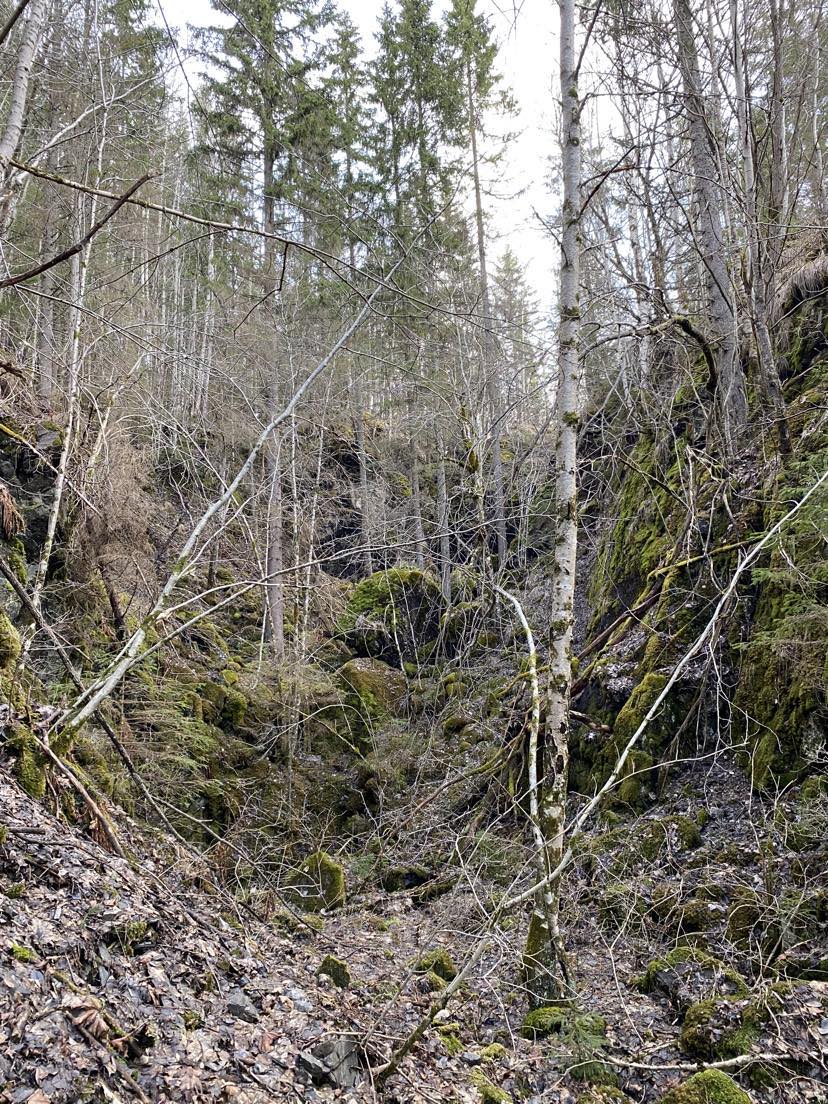
The Pajsberg Mining Field
In addition to the Harstig Mine, the Pajsberg mining field includes Flaks Mine, Björk Mine, Olov Jans Mine, Jon Jans Mine, and Pajsberg Mine, all within the claim area of the Pajsberg Mine.
The Pajsberg mining claim was established on 10 September 1883, and the owner of the claim was Josef M. Berglund.
Brief description of the map of the Pajsberg Mine in Fernebo parish, Värmland County
The mine is located near the northern end of the easternmost of the inlets extending northward from Lake Yngen.
The surrounding rock consists of limestone, forming a southern continuation of the limestone area in which the mines of Långban are situated. These mines share the characteristic that they contain hematite (iron ore) and manganese ore (hausmannite), both of which are utilized.
The mine was reopened from abandonment in 1884 and was worked until near the end of 1887, when it was closed because the manganese ore—on which the operation mainly depended—had declined, and the remaining iron ore alone was not profitable to extract under the prevailing conditions.
The manganese ore was used partly as an additive in Bessemer charging at nearby blast furnaces, and partly in glass manufacturing.
Rock and water were hoisted by means of a small steam engine.
An older map has, where accessible, been surveyed by the undersigned, who also carried out the final completion.
Persberg, February 1888
P. Öberg
Copy by TN. The original document is available under texts.
From “Extracts from the reports on the mines of the Filipstad Mining District from 1880 to 1895” (page 71)
1884
Deepening work was carried out in the old mine on the small hematite ore deposit found there, which is associated with manganese ore. The main work took place to obtain the latter ore, which here, as in the Långban field, occurs together with iron ore. Whether the mine can be profitably worked therefore depends on the amount of manganese ore that can be extracted.
1885
In September the mine had a length of 36 m and an average width at the bottom of 3.6 m.
The ore body strikes northwest–southeast, with a dip toward the southwest and a clear field dip toward the northwest.
In the southeastern part of the bottom there is iron ore for about half of its length, and in the northwestern part there is manganese ore (hausmannite).
The proportion between the two ore types will likely continue to vary in the future as it has previously.
To strengthen the wall, a band has been left in the southeastern end at a depth of 53.5 m.
The year’s mining yielded good results since manganese ore had a high value relative to iron ore.
At the surface along the same line as the mine workings but closer to the lakeshore, a weathered and very loose manganese ore has been exposed.
1886
During the year the bottom of the mine was lowered to a depth of 74 m.
The manganese ore appears to have increased somewhat while the iron ore has decreased.
The rock raised contained 52.11 percent ore, of which 34.87 percent iron ore and 17.24 percent manganese ore.
The result of the year’s mining was good.
1887
As the iron ore increased during the year and the manganese ore decreased, work was stopped on 1 December.
At that time the mine was 114 m deep with an ore bottom 19.6 m long and 2–2.4 m wide.
The southeastern part of the bottom consisted of iron ore, while the northwestern part contained only a small amount of manganese ore.
Transcribed by Jan Kruse, 16 April 2024.
The spelling has been modernized.
Parking at the old Road 63, about 100 m south of the houses at Prästbacken.
In addition to the Harstig Mine, the Pajsberg mining field includes Flaks Mine, Björk Mine, Olov Jans Mine, Jon Jans Mine, and Pajsberg Mine, all within the claim area of the Pajsberg Mine.
The Pajsberg mining claim was established on 10 September 1883, and the owner of the claim was Josef M. Berglund.
Brief description of the map of the Pajsberg Mine in Fernebo parish, Värmland County
The mine is located near the northern end of the easternmost of the inlets extending northward from Lake Yngen.
The surrounding rock consists of limestone, forming a southern continuation of the limestone area in which the mines of Långban are situated. These mines share the characteristic that they contain hematite (iron ore) and manganese ore (hausmannite), both of which are utilized.
The mine was reopened from abandonment in 1884 and was worked until near the end of 1887, when it was closed because the manganese ore—on which the operation mainly depended—had declined, and the remaining iron ore alone was not profitable to extract under the prevailing conditions.
The manganese ore was used partly as an additive in Bessemer charging at nearby blast furnaces, and partly in glass manufacturing.
Rock and water were hoisted by means of a small steam engine.
An older map has, where accessible, been surveyed by the undersigned, who also carried out the final completion.
Persberg, February 1888
P. Öberg
Copy by T Nordwall. The original document is available under texts.
From “Extracts from the reports on the mines of the Filipstad Mining District from 1880 to 1895” (page 71)
1884
Deepening work was carried out in the old mine on the small hematite ore deposit found there, which is associated with manganese ore. The main work took place to obtain the latter ore, which here, as in the Långban field, occurs together with iron ore. Whether the mine can be profitably worked therefore depends on the amount of manganese ore that can be extracted.
1885
In September the mine had a length of 36 m and an average width at the bottom of 3.6 m.
The ore body strikes northwest–southeast, with a dip toward the southwest and a clear field dip toward the northwest.
In the southeastern part of the bottom there is iron ore for about half of its length, and in the northwestern part there is manganese ore (hausmannite).
The proportion between the two ore types will likely continue to vary in the future as it has previously.
To strengthen the wall, a band has been left in the southeastern end at a depth of 53.5 m.
The year’s mining yielded good results since manganese ore had a high value relative to iron ore.
At the surface along the same line as the mine workings but closer to the lakeshore, a weathered and very loose manganese ore has been exposed.
1886
During the year the bottom of the mine was lowered to a depth of 74 m.
The manganese ore appears to have increased somewhat while the iron ore has decreased.
The rock raised contained 52.11 percent ore, of which 34.87 percent iron ore and 17.24 percent manganese ore.
The result of the year’s mining was good.
1887
As the iron ore increased during the year and the manganese ore decreased, work was stopped on 1 December.
At that time the mine was 114 m deep with an ore bottom 19.6 m long and 2–2.4 m wide.
The southeastern part of the bottom consisted of iron ore, while the northwestern part contained only a small amount of manganese ore.
Transcribed by Jan Kruse, 16 April 2024.
The spelling has been modernized.
Parking at the old Road 63, about 100 m south of the houses at Prästbacken.


