Laddar...
Persberg Canal
 Canal
CanalCoordinates: 59.76628, 14.25474 (WGS84)
Lengthapprox. 6 km
Head34 m (Steffansson's measurements, 1860)
Flow0.412 m³/s (Steffansson's measurements,
1860)Year built1820
Head34 m (Steffansson's measurements, 1860)
Flow0.412 m³/s (Steffansson's measurements,
1860)Year built1820
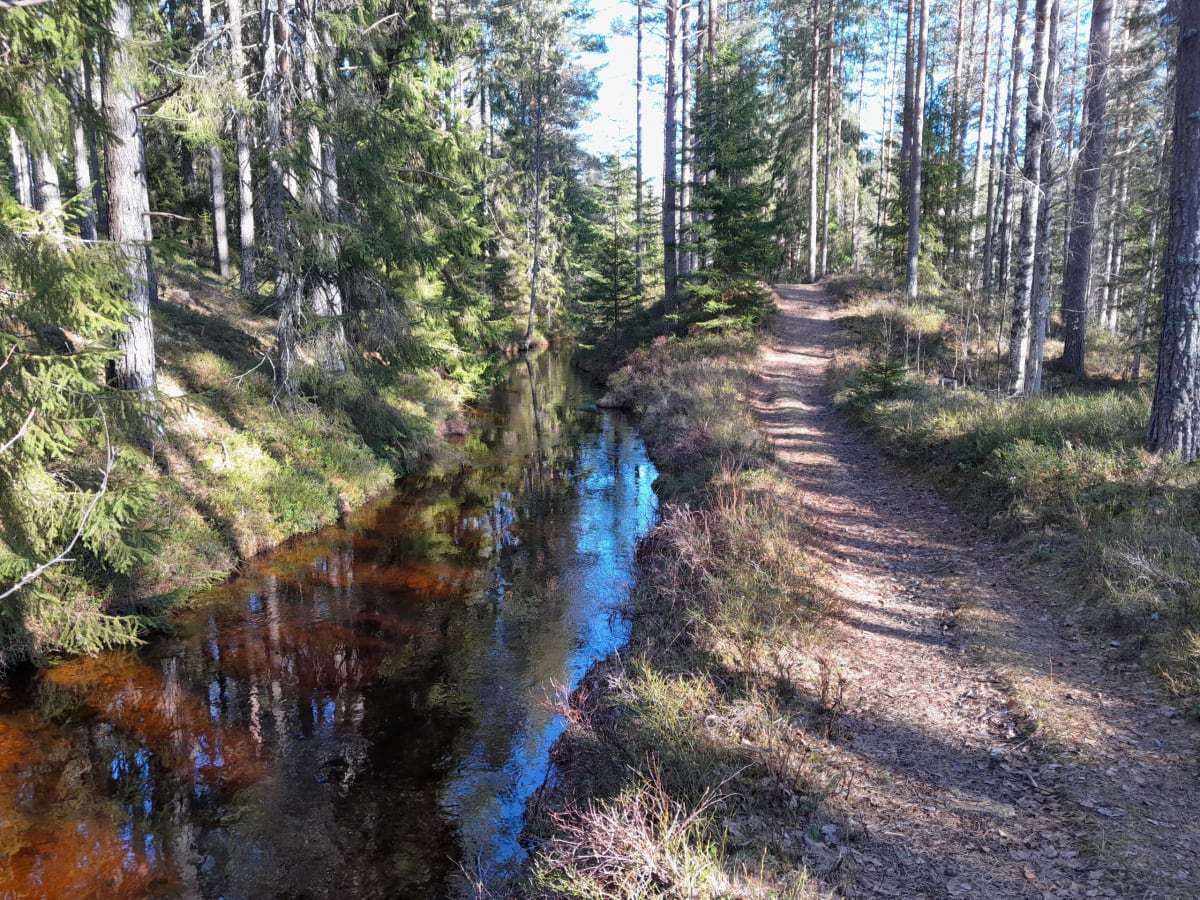
Lengthapprox. 6 km
Head34 m (Steffansson's measurements, 1860)
Flow0.412 m³/s (Steffansson's measurements,
1860)Year built1820
Head34 m (Steffansson's measurements, 1860)
Flow0.412 m³/s (Steffansson's measurements,
1860)Year built1820
Persbergs Canal – Why It Was Built Source: Report to the Board of Directors of the Iron Office (Jernkontoret) on the structures and water supply at Persbergs Iron Ore Field in Värmland, Year 1820. Author: Gustaf Uhr, Director and Mining Mechanician. Transcript: TN
Background – the existing watercourse and its shortcomings
The natural watercourse Yngshytte-Elf, between the lakes Horrsjön and Yngen, formed seven separate falls that had long been used for milling, sawing, and mining operations. However, these falls had several serious deficiencies:
- Too low a head – each fall was only approx. 10 feet high, despite the total head between the lakes amounting to 114 feet. The remainder was taken up by rapids with no usable fall.
- Too great a distance – the falls were located far from the mines they were meant to serve, requiring very long pump rods.
- High maintenance costs – the long machinery was difficult and costly to keep in order. One section was barely repaired before another broke down.
- Insufficient power – friction in the long machinery consumed a large part of the already limited power, and frequent repairs meant operations were constantly interrupted.
Consequences for mining operations
The inadequate machinery had direct consequences for the mines:
- The most important mines could not be worked at the bottom, but were forced to operate in the side walls or – as in Storgruvan – in the ceiling of the working chambers.
- The supply of pump rods decreased steadily while demand increased, threatening to make it impossible to maintain the old machinery.
Origin and execution of the project
| Year | Event |
|---|---|
| 1818 | The question of a new water channel through the ore field arose at the Commission proceedings in Värmland |
| 1818 (autumn) | Master Mechanic Bransell conducted a survey |
| 1819 | The survey was reviewed by Gustaf Uhr, who drew up a plan for the entire project |
| 1820 | Work commenced |
| 19 Nov 1821 | Project substantially completed |
Upon completion, the new machinery for Högbergsfältet, Storgruvan, and Haggruvan was in full operation, and Krangruvan’s engine house and wheel structures were approximately ¾ complete. The mill site was prepared and machinery procured.
The principal purpose of the water channel
Savings in maintenance costs were therefore not the only – or even the primary – objective. The main purposes were:
- Sufficient power close to the mines – to install water wheels with adequate or surplus power at locations within the ore field, from which drive rods could conveniently be directed to any of the surrounding mines.
- New installations – to create falls and building sites for winding gear (for ore hoisting), a mill, and a sawmill.

