Laddar...

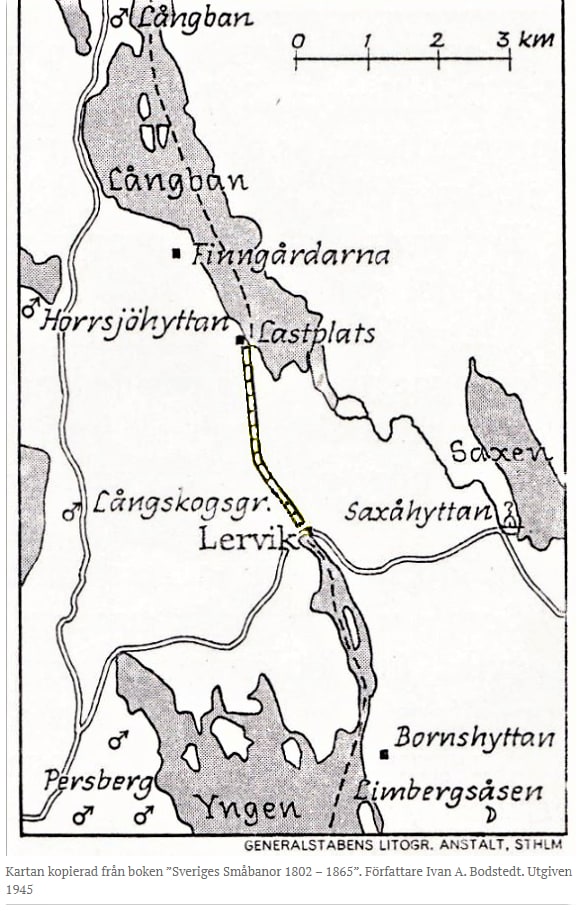
Lerviks Railroad
Track Gauge
The track gauge stated in the book is considered incorrect by several sources.
The correct gauge is 28 Swedish inches (verktum) = 693 mm.
Map and Source
The map and text are copied from the book “Sweden’s Minor Railways 1802–1865” by Ivan A. Bodstedt, published in 1945 on behalf of the Swedish State Railways.
Permission to use the copied text from the book has been granted by the Swedish Railway Museum in Gävle.
Their hope was that this would help create an interest in railway history.
Traffic on Lake Långban
In Ivan Bodstedt’s book it is noted, under the images on page 109, that traffic on Lake Långban during the summer was maintained by a barge.
Director Gustav Ekman had installed a caloric engine (hot-air engine) in the vessel. It worked well for many years but was eventually replaced by a steam engine.
The boat is said to have been able to carry a load of 85 tons.
Transport of the Hot-Air Engine
In the list of transported goods on the Lervik Railway in 1860, it is recorded that a hot-air engine was transported by rail. The list can be seen in image 9.
The hot-air engine also appears in the list of goods transported on the Yngs–Daglöse Railway in 1860, and was therefore transported across Lake Yngen from Vinternäset to Lervik.
It is quite likely that the hot-air engine listed in these transport records is the same engine that was installed in the tugboat Sumpadoria, whose home port was Lesjöfors.
Sumpadoria was built in 1860.
The Cargo Boat Sjöhästen
Image 11 shows a document concerning the sale of Samuel Jernberg’s share in the cargo boat Sjöhästen on Lake Långban to master builder O. Bergström of Persberg.


